32 VAT Exempted & Zero-rated Goods & Services in Nigeria
All 17 zero-rated and 15 exempt goods and services under the Nigeria Tax Act 2025, and what the difference costs a seller in input VAT.

Two sellers issue invoices with no VAT on them. At quarter end, one gets ₦75,000 back from the Nigeria Revenue Service (NRS). The other absorbs the same ₦75,000 as a cost and gets nothing. The goods look alike on the invoice. The law treats them differently, and the difference is one word: zero-rated or exempt.
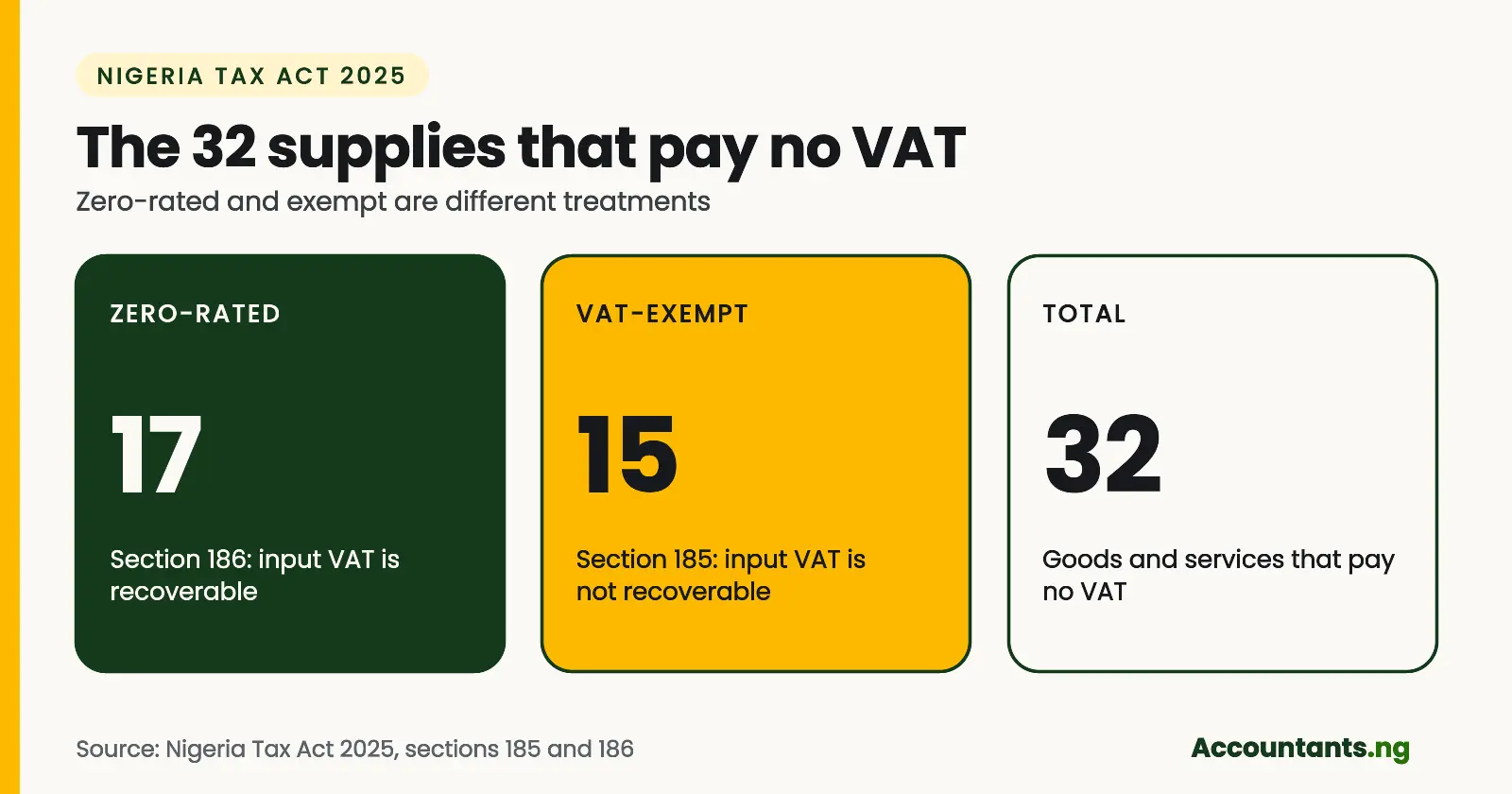
Thirty-two supplies are the goods that pay no VAT in Nigeria under the Nigeria Tax Act 2025 (NTA). Seventeen are zero-rated (section 186) and fifteen are exempt (section 185). Customers pay no VAT on either kind. The seller's side is where the money moves.
We re-read sections 185 to 188 and the Eleventh Schedule word for word on 8 November 2026 and checked the 17 and 15 count line by line. The full list is below, with a worked naira example, an item lookup and the invoice mistakes that cost sellers most.
What is the difference between zero-rated and exempt?
A zero-rated supply is still a taxable supply. The rate is simply 0%. An exempt supply sits outside VAT altogether. That single distinction decides whether the seller can recover the VAT it paid on its own costs.
| Point | Zero-rated | Exempt |
|---|---|---|
| VAT charged to customer | 0% | None |
| Input VAT on seller's costs | Recoverable | Not recoverable |
| Where it sits in the Act | Section 186 | Section 185 |
| Number of items | 17 | 15 |
| Typical result for the seller | Credit or refund | Cost in the accounts |
The Act sets the recovery rule in section 155(4). Input tax is deductible only to the extent it was incurred in making taxable supplies. Where a cost serves both taxable and non-taxable supplies, only the taxable share counts. The NRS says the same in Information Circular 2026/17, its Guidelines on Tax Refund of 29 June 2026. Section 11.4 states that input VAT on exempt items cannot be claimed against output VAT and should be expensed in the income statement.
What does the difference cost? A worked example
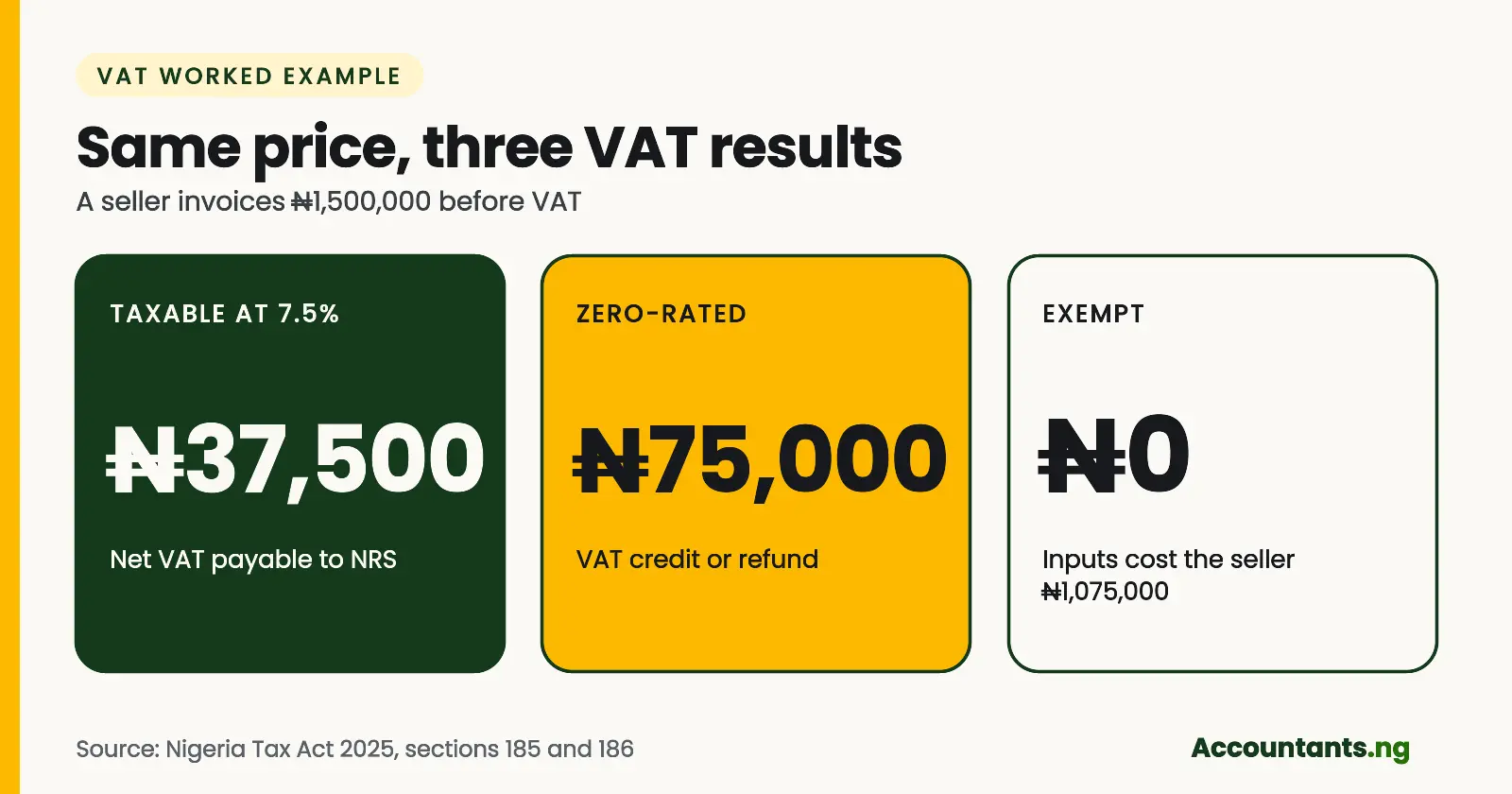
Take a seller with ₦1,000,000 of costs, carrying ₦75,000 of input VAT (7.5% of ₦1,000,000). It sells the output for ₦1,500,000 before any VAT. Here is the same business under three treatments.
| Line | Taxable at 7.5% | Zero-rated | Exempt |
|---|---|---|---|
| Price before VAT | ₦1,500,000 | ₦1,500,000 | ₦1,500,000 |
| Output VAT (7.5% or 0%) | ₦112,500 | ₦0 | ₦0 |
| Customer pays | ₦1,612,500 | ₦1,500,000 | ₦1,500,000 |
| Input VAT recovered | ₦75,000 | ₦75,000 | ₦0 |
| Net VAT to NRS | ₦37,500 payable | ₦75,000 credit or refund | ₦0 |
| Real cost of inputs | ₦1,000,000 | ₦1,000,000 | ₦1,075,000 |
| Profit before tax | ₦500,000 | ₦500,000 | ₦425,000 |
The arithmetic: ₦1,500,000 × 7.5% = ₦112,500 output VAT. Less ₦75,000 input VAT leaves ₦37,500 to pay. For the zero-rated seller, ₦0 output less ₦75,000 input leaves ₦75,000 owed to the business, which section 155 lets it carry forward as a credit or claim as a refund. The exempt seller recovers nothing, so its costs are ₦1,000,000 + ₦75,000 = ₦1,075,000, and profit falls by ₦75,000.
The customer pays no VAT in the last two columns. Only the seller feels the gap. That is why traders in exempt lines, such as baby products or farm equipment, should price their input VAT into their margins.
Which 17 goods and services are zero-rated?
These are in section 186. The terms are defined in section 188.
- Basic food items. Staple agricultural or aquatic foods: locally produced table honey, white and brown bread, cereals (maize, rice, wheat, millet, barley, sorghum, oats, fonio, finer millet), cooking oils fit for culinary use, culinary herbs, fish other than ornamental, flour and starch such as garri, fruits, live or raw meat and poultry eggs, milk, nuts, pulses, tubers, salt for culinary use, vegetables, and natural and table water. Sparkling or flavoured water, and water sold in restaurants, hotels, cafes and similar settings or by caterers and contractors, are excluded.
- Medical and pharmaceutical products, including medicinal herbal products. Pharmaceutical products must be approved by the relevant regulatory authority. Cosmetology and fitness devices are excluded.
- Educational books and materials, physical or electronic. These include newspapers, journals, periodicals, children's books, printed music and maps.
- Fertilisers for agricultural purposes.
- Locally produced agricultural chemicals, meaning drugs and vaccines made in Nigeria to treat plants, such as pesticides and herbicides.
- Locally produced veterinary medicine for animals and fish.
- Locally produced animal feeds for poultry, cattle, fish and similar animals.
- Live cattle, goats, sheep and poultry.
- Agricultural seeds and seedlings.
- Electricity from generation companies (GENCOs) supplied to the National Grid or the Nigeria Bulk Electricity Trading Company (NBET).
- Electricity transmitted by the Transmission Company of Nigeria (TCN) to the distribution companies (DISCOs).
- Medical services, meaning healthcare for humans or animals by a qualified health practitioner. Cosmetology, spa and gymnasium services are excluded.
- Tuition for nursery, primary, secondary or tertiary education.
- Exported goods, other than oil and gas. These are goods produced or procured for commercial purposes in Nigeria and supplied to a person outside Nigeria.
- Exported services.
- Exported incorporeal property.
- Medical equipment used to diagnose and treat disease or to help recovery, including veterinary equipment. Cosmetology and fitness devices are excluded.
Which 15 supplies are VAT-exempt?
These are in section 185(1). The numbering continues from the zero-rated list.
- Oil and gas exports.
- Crude petroleum oil and feed gas for all processed gas.
- Goods bought for humanitarian donor-funded projects. The donor must first pay the VAT and then request a refund from the NRS. NGO projects and not-for-profit religious and social societies recognised by law are included.
- Baby products for children from birth to 3 years: clothing, cots, feeding bottles, diapers, baby creams, carriers and monitors among them.
- Locally manufactured sanitary towels, pads or tampons.
- Military hardware, arms and ammunition, and locally made uniforms supplied to the armed forces, para-military and other security agencies of a Nigerian government.
- Shared passenger road transport open to the general public. Leased, hired or rented vehicles and car or ride hailing are excluded.
- Purchase, hire, rental or lease of tractors, ploughs and other agricultural equipment.
- Supplies consumed by an approved entity in export processing or free trade zones, on its approved activity.
- Goods and services for diplomatic missions and diplomats recognised under the Diplomatic Immunities and Privileges Act, where the activity is in the public interest and not for profit.
- Plays and performances by educational institutions as part of learning.
- Land or buildings, including an interest in land or a building.
- Money, stakes or securities, including an interest in money or securities.
- Government licences.
- Assistive devices and disability-related products, including hearing aids, wheelchairs and braille materials.
Is my everyday item on the list?
Use this table for quick answers. Where the Act is silent, we say so rather than guess.
| Item | Treatment | Basis |
|---|---|---|
| Rice, garri, yam, beans | Zero-rated | Section 186(a) |
| White or brown bread | Zero-rated | Named in section 188 |
| Bottled table water | Zero-rated | Sparkling or flavoured excluded |
| Water in a restaurant or hotel | Taxable at 7.5% | Excluded in section 188 |
| School tuition | Zero-rated | Section 186(m) |
| Approved medicines | Zero-rated | Section 186(b) |
| Doctor's or hospital care | Zero-rated | Section 186(l) |
| Baby diapers | Exempt | Section 185(1)(d) |
| Sale of land or a building | Exempt | Section 185(1)(l) |
| Building rent | Exempt, as an interest in a building | Section 185(1)(l); confirm your lease with the NRS |
| Public bus fare | Exempt | Section 185(1)(g) |
| Ride hailing | Taxable at 7.5% | Excluded in section 188 |
| Bank charges | Not named | Money is exempt; the Act does not name bank fees |
| Soft drinks, biscuits | Not named, so taxable | Section 147 |
| Petrol, diesel | On hold | Eleventh Schedule |
Everything not named on either list is taxable at 7.5% under section 147. The definitions are narrow, so read them before you leave VAT off an invoice.
What changed from the old VAT Act?
The old Value Added Tax Act ceased to apply after 31 December 2025, and the NTA took effect on 1 January 2026, according to BDO Nigeria (31 March 2026). The rate stayed at 7.5%. Three changes matter most for this list, as set out by Forvis Mazars (16 March 2026).
- Basic foodstuffs, medical supplies and educational materials, previously exempt, are now zero-rated, so their suppliers can claim input VAT.
- Purchases by diplomatic missions, previously zero-rated, are now exempt, so suppliers cannot recover input VAT on them.
- Input VAT on services and fixed assets, not claimable before, is now claimable for taxable supplies, within five years and only from 1 January 2026.
Is VAT charged on petrol and gas yet?
Not by default. The Eleventh Schedule lists petroleum products, renewable energy equipment, compressed natural gas (CNG), liquefied petroleum gas (LPG) and other gaseous hydrocarbons. VAT on them starts on a date the Minister sets by order in the Federal Government Gazette, and the Minister may suspend it in the public interest (section 185(2)).
The Schedule defines petroleum products as automotive gas oil, aviation turbine kerosene, premium motor spirit, household kerosene and locally produced LPG. It also lets the Minister class CNG and LPG conversion equipment and services as exempt or zero-rated. We found no published commencement order on 8 November 2026. Check the Gazette and the NRS before you price fuel.
One more route to exemption exists. Where a government agency signs a development financing agreement that exempts a project's supplies from VAT, the President can give it effect by gazetted order (section 187).
Which invoice mistakes cost sellers the most?
- Charging 7.5% on a zero-rated item. You may claim the VAT back. The NRS lists VAT charged and remitted on zero-rated and exempt supplies as a refund ground (Circular 2026/17, section 4(f)), with proof of remittance and the tax invoice.
- Missing the 12-month window. A refund request must reach the NRS within 12 months of the transaction. After that the right is lost.
- Claiming input VAT on an exempt sale. Section 11.4 of the circular says expense it. An audit can reverse the claim.
- Treating oil and gas exports as zero-rated. Other exports are zero-rated. Oil and gas exports are exempt.
- Stretching a definition. Restaurant water, ride hailing and medicines without regulatory approval all fall outside the relief.
- Dropping the rate from the invoice. Section 152 requires the VAT charged and the rate on every VAT invoice, and the invoice must be issued whether or not payment is made.
Not sure whether your item is on the list? Read the definition in section 188 first, then decide zero-rated or exempt, because that choice sets your input VAT. For the full rules on invoices, input VAT and refunds, read the VAT guide. ICAN students can use the ICAN note on VAT scope, registration and rates.
Frequently asked questions
How many goods and services pay no VAT in Nigeria?
Seventeen are zero-rated under section 186 and fifteen are exempt under section 185, which makes 32 in total. Customers pay no VAT on any of them. Petroleum products, renewable energy equipment and some gases sit apart in the Eleventh Schedule, where VAT collection waits for a ministerial order.
Is rice zero-rated or exempt?
Zero-rated. Section 188 names rice among the cereals that count as basic food items, in grain or flour form, raw or semi-processed, in bulk or retail. Section 186(a) zero-rates basic food items, so the seller charges 0% and can still recover the input VAT on its costs.
Are school fees subject to VAT?
No. Section 186(m) zero-rates tuition for nursery, primary, secondary and tertiary education. The word is tuition. The Act does not say that every other charge a school makes is covered, so check items such as uniforms or transport against the two lists before you leave VAT off.
Can I claim input VAT on exempt supplies?
No. NRS Information Circular 2026/17, section 11.4, says input VAT on exempt items cannot be claimed against output VAT and should be expensed. Zero-rated sellers can claim. Where one cost serves both taxable and exempt supplies, section 155(4) allows only the taxable share.
How long do I have to claim a VAT refund?
Twelve months from the date of the transaction that generated the claim, under section 10.1 of NRS Information Circular 2026/17. Miss that date and the right to the refund is lost. Once a valid request arrives, the NRS must act within 30 days, either by refunding the amount or setting it off.
Is VAT charged on petrol now?
Petroleum products are in the Eleventh Schedule, so VAT collection starts only on a date the Minister sets by gazetted order. We found no published commencement order when we checked on 8 November 2026. Confirm the current position with the NRS before you price fuel.
Do small businesses charge VAT?
A small company earns gross turnover of ₦100,000,000 or less and holds fixed assets of ₦250,000,000 or less (section 201). Forvis Mazars reports that such businesses are exempt from VAT registration, charging, filing and remittance, but professional service providers are excluded. Confirm your own position with the NRS.
Check what VAT you owe on a taxable sale with the VAT calculator.
Keep reading

How to Register for a Tax ID (TIN) in Nigeria
There is no TIN form: get a NIN or register with CAC, then retrieve your 13-digit Tax ID, with the legal basis, penalties and...
7 Nov 2026 6 min read
How to Update Your Tax ID Information
Your Tax ID never changes, so correct the NIN or CAC record behind it and tell your tax authority within 30 days under the...
7 Nov 2026 6 min read
How to Check Your Tax ID Number in Nigeria
Open taxid.nrs.gov.ng, select Individuals or Corporate, enter your NIN or CAC number and read off your 13-digit Tax ID, with the law and fixes...
7 Nov 2026 7 min readGet new articles by email
Exam tips, study guides and the law in plain English. No spam, and you can leave at any time.