Types of accounting: branches, uses and how to choose
The main branches of accounting are financial, management, cost, public sector, tax, auditing and forensic accounting, with fund, environmental, social and international accounting as smaller fields. Each branch answers a different question for a different reader: investors, managers, government, tax officers or donors. This guide maps them and shows how to choose.
Here is a test. A baker in Abeokuta sells 2,000 loaves in a month at ₦1,500 each. One person wants the profit. A second wants the cost of one loaf. A third wants to know how many loaves cover the rent and wages, and the tax office wants a taxable figure. That is four questions from one set of books, and each belongs to a different branch. By the end of this guide you will know which is which.
What are the branches of accounting?
Accounting is the practice of recording, classifying and reporting financial information so that someone can make a decision. The branches exist because decision makers differ. An investor reading a published annual report needs something different from a production manager who must price tomorrow's batch.
Textbooks disagree on the count. Some say three branches, some five, some eight or more. The argument is mostly about whether auditing and tax count as accounting or as close neighbours. This guide uses a working map of five groups, so you can place any branch you meet in a syllabus or a job advert:
- Reporting to outsiders: financial accounting and corporate accounting.
- Deciding inside the business: cost accounting and management accounting.
- Serving government and public causes: public sector accounting, fund accounting and non-profit accounting.
- Checking and complying: auditing, tax accounting and forensic accounting.
- Specialist lenses: environmental, social, human resource and international accounting.
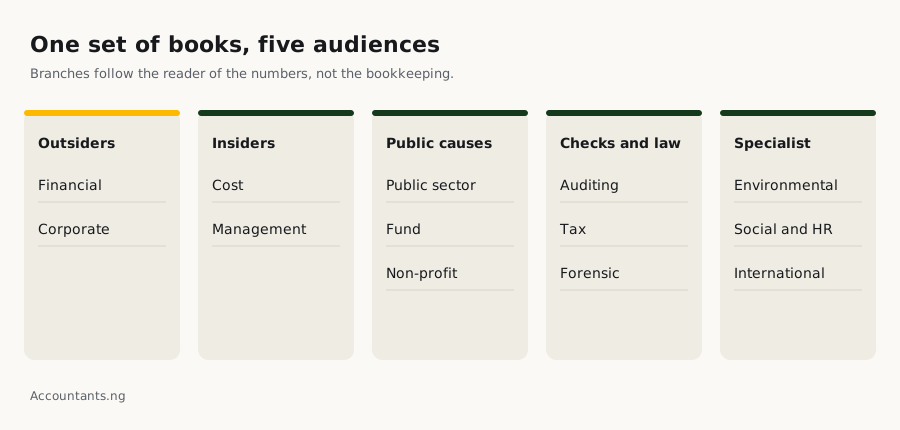
Notice that the groups follow the reader, not the bookkeeping. The same sale of bread is recorded once, then looked at five different ways. That idea explains almost every branch below.
The main branches at a glance
The table gives each branch in one line: the question it answers, who reads the answer, and where you meet it in Nigeria. Use it as a map, then read the sections that follow for the branches that matter to you.
| Branch | The question it answers | Main reader | Where you meet it |
|---|---|---|---|
| Financial accounting | How did the business perform, and what does it own and owe? | Owners, lenders, regulators | Annual financial statements of a company |
| Corporate accounting | How are shares, loans, mergers and company law reflected in the books? | Shareholders, the Corporate Affairs Commission | Share issues and company reports under CAMA |
| Cost accounting | What does one unit, job or service cost to make? | Production and pricing managers | Factories, bakeries, printers, contractors |
| Management accounting | What should we do next, given the numbers? | Directors and department heads | Budgets, break-even studies, performance reviews |
| Public sector accounting | Was public money spent as approved? | Legislators, citizens, auditors | Ministries, agencies and state governments |
| Fund and non-profit accounting | Was each restricted gift spent on its purpose? | Donors, trustees | Churches, charities, schools, foundations |
| Tax accounting | How much tax is due, and when? | Tax authorities, owners | Tax returns and deferred tax workings |
| Auditing | Can we trust these accounts? | Shareholders, regulators, lenders | The auditor's report on company accounts |
| Forensic accounting | What happened to the money, and can we prove it? | Courts, investigators, boards | Fraud inquiries and disputes |
| Environmental accounting | What do our activities cost the environment, and us? | Managers, regulators, communities | Oil, gas, mining and manufacturing firms |
| Social and human resource accounting | What is the value of people and social impact? | Managers, employees, communities | Staff training budgets and impact reports |
| International accounting | How do we compare accounts across countries? | Multinational groups, investors | Groups with foreign subsidiaries |
Two branches deserve an early warning. Corporate accounting is not a separate method of bookkeeping. It is financial accounting applied to the rules that govern companies. And auditing is not record-keeping at all. An auditor checks someone else's records. Both points come back later.
Financial, cost and management accounting: one bakery, three answers
These three branches cause the most confusion in the first year, because they all use the same numbers. Take the baker from the start. In the month she sold 2,000 loaves at ₦1,500, so sales were ₦3,000,000. Flour and other materials cost ₦1,200,000, bakers' wages ₦400,000 and rent and power ₦300,000. Delivery cost ₦150,000.
| Branch | Question | Working | Answer |
|---|---|---|---|
| Financial accounting | What was the profit for the month? | 3,000,000 sales less 1,900,000 cost of sales less 150,000 delivery | ₦950,000 profit before tax |
| Cost accounting | What does one loaf cost to make? | 1,900,000 divided by 2,000 loaves | ₦950 per loaf |
| Management accounting | How many loaves cover the fixed costs? | Fixed costs 450,000 divided by contribution of 700 per loaf | 643 loaves (rounded up) |
The contribution of ₦700 is the selling price of ₦1,500 less ₦800 of variable cost per loaf, which is materials and wages of ₦1,600,000 divided by 2,000. The fixed costs are rent and power plus delivery, ₦300,000 and ₦150,000. Check the answer: 2,000 loaves at ₦700 give ₦1,400,000, less ₦450,000 of fixed costs, which returns the ₦950,000 profit. The numbers agree because they come from one set of books.
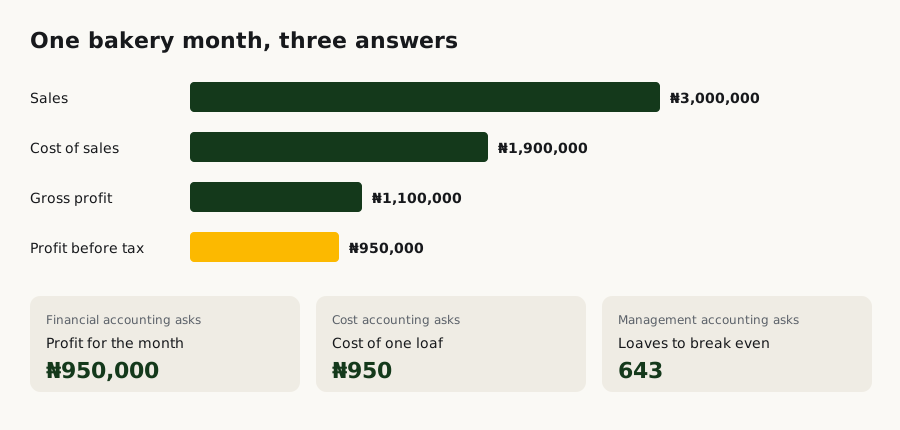
Now the lesson. Financial accounting looks backwards and reports to outsiders under set rules. Cost accounting works out what things cost. Management accounting looks forwards and has no outside rulebook, so a baker can design a report that suits her decision. If the margin of safety (here 2,000 less 643, which is 1,357 loaves) looks comfortable, she can price a discount order with more confidence.
The ICAN Foundation Financial Accounting notes teach the bookkeeping underneath all three. Later, the Performance Management notes cover costing and break-even work in depth.
What are public sector, fund and non-profit accounting?
These branches answer to people who are not owners. A shareholder wants profit. A taxpayer, a donor or a legislator wants proof that money went where it was meant to go.
Public sector accounting records the income and spending of government bodies. Its test is accountability against the approved budget, not profit. Nigeria's public sector works towards International Public Sector Accounting Standards (IPSAS), and the accounting principles guide sets out the dates and the standards behind them. Many public bodies reported on a cash basis for years before moving to accruals, so you will still meet both bases in practice.
Fund accounting tracks money by purpose. Suppose a donor gives a foundation ₦5,000,000 for scholarships only. The foundation cannot spend it on office rent, even if the rent account is overdrawn. It opens a scholarship fund, records gifts and spending in that fund, and reports the balance to the donor. Non-profit accounting applies the same idea to charities, churches, schools and clubs, where the question is stewardship rather than profit.
If you work toward ICAN, the Public Sector Accounting and Finance notes cover this branch.
How do tax accounting and auditing differ from accounting?
Both sit close to accounting and both depend on it, but neither is simple bookkeeping. They answer different questions, and the people who do them often work independently of the company's own accountants.
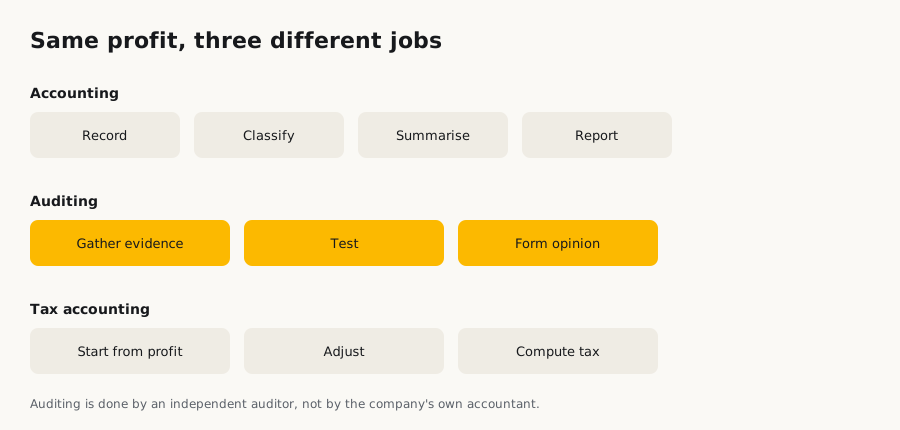
Tax accounting starts with the accounting profit and adjusts it to a taxable figure under tax law. Spending that the accounts treat as an expense may not be deductible, and income may be taxed in a different period from the one the accounts use. That gap is also the source of deferred tax. The Nigeria Tax Act 2025 took effect on 1 January 2026, according to the federal government's transition guidelines, so older textbooks may quote rules that no longer apply. Our guide to the Nigeria Tax Act 2025 follows the sections.
Auditing is an independent examination of the accounts, ending in an opinion on whether they give a fair view. The Companies and Allied Matters Act 2020 requires companies to appoint auditors, with an exemption for small companies, and the CAMA 2020 guide gives the details. The key point is independence. A company's own accountant prepares the accounts, and a separate auditor tests them. Mixing the two roles defeats the purpose.
One bakery example shows the split. The accountant records the ₦3,000,000 of sales. The auditor asks for delivery notes and bank statements to confirm those sales happened. The tax adviser then decides how much of the ₦950,000 profit is taxable. Three jobs, three skills, one profit figure.
Forensic, environmental, social, human resource and international accounting
The specialist branches apply accounting skills to narrower problems. Most students meet them as short topics, and a few build careers in them.
Forensic accounting investigates fraud and financial disputes and presents the findings so a court or board can rely on them. The skills are accounting, plus careful evidence handling and clear report writing. If you enjoy following a trail of transactions, this is where the work is closest to detective work.
Environmental accounting measures the financial cost of environmental effects, such as waste clean-up, emissions or land restoration. It matters most where operations touch land and water, which is why oil, gas, mining and manufacturing firms use it more than a retail shop does.
Social accounting and human resource accounting try to put figures on what ordinary books leave out: the value of staff training, or a company's effect on its host community. These figures are estimates, so treat them as management information rather than audited fact.
International accounting deals with comparing accounts across countries and combining the accounts of a group with foreign subsidiaries. Nigeria has used IFRS for listed companies since 2012, which removes a large part of the difference for those entities, as the principles guide explains.
Which branch should you study or work in?
Start from what you enjoy, not from what you have heard pays best. This guide publishes no salary figures, because we have no verified Nigerian source, and pay varies by employer, city, qualification and experience. The table links tastes to branches and gives a first step.
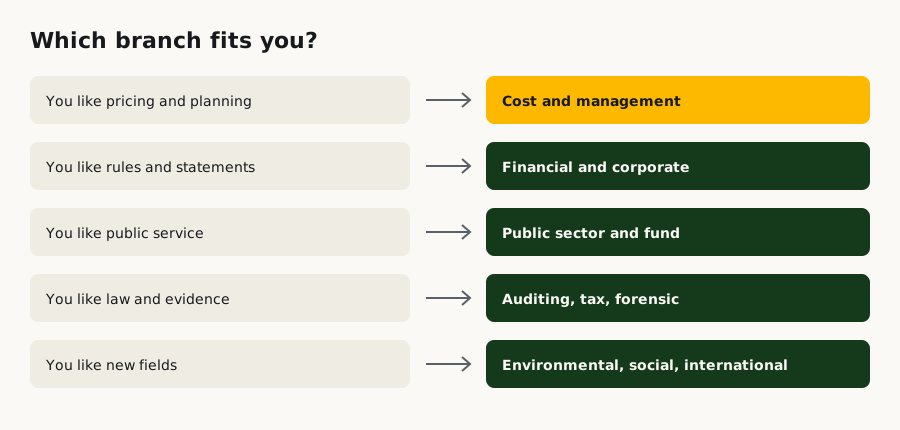
| If you enjoy | Look at | First step |
|---|---|---|
| Rules, statements and getting the numbers right | Financial accounting and corporate accounting | Financial Reporting notes |
| Pricing, budgets and planning | Cost and management accounting | Performance Management notes |
| Public service and accountability | Public sector, fund and non-profit accounting | Public Sector Accounting and Finance notes |
| Law, evidence and independence | Auditing, tax and forensic accounting | CAMA 2020 guide |
| Cash, investment and funding decisions | Financial management | Financial Management notes |
In Nigeria, you qualify through a professional body. The IFAC member page for ICAN records that the Institute was established by Act No. 15 of 1 September 1965. A second route runs through the Association of National Accountants of Nigeria, whose Act commenced on 25 August 1993. Both bodies publish their own syllabuses and entry rules, so check them before you enrol.
If you are still choosing a degree, read the guide to accounting cut-off marks first. When you are ready to study, open the ICAN Foundation level, which gives you the base for every branch above.
Common mistakes when learning the branches
Four slips cost beginners marks and time:
- Treating the branches as separate subjects. They use the same ledgers. A strong grasp of double entry helps in all of them.
- Calling auditing accounting. The accountant prepares and the auditor checks. Exam answers that blur the two lose marks.
- Mixing cost and management accounting. Cost accounting finds what things cost. Management accounting uses costs and other data to guide decisions.
- Quoting old tax rules. Check the date on any tax material, because the Nigeria Tax Act 2025 took effect on 1 January 2026.
Most of these errors start in the same place: memorising names without asking who the reader is. Ask that first and the branch usually names itself.
Frequently asked questions
What are the branches of accounting?
The usual branches are financial, cost, management, public sector, fund and non-profit, tax, forensic, environmental, social, human resource and international accounting, with auditing taught alongside. Authors count them differently, so exams usually accept any reasoned list that explains each branch's purpose and reader.
What are the three main branches of accounting?
Most textbooks name financial accounting, cost accounting and management accounting as the three main branches. Financial accounting reports to outsiders, cost accounting finds the cost of products and services, and management accounting supports decisions inside the business. Other branches build on these three.
What is the difference between financial and management accounting?
Financial accounting reports past results to outsiders such as owners and lenders, and follows set standards. Management accounting serves managers, looks forward, and follows no outside rulebook. The bakery example above shows both: a profit of ₦950,000 versus a break-even of 643 loaves.
Is auditing a branch of accounting?
Many syllabuses treat auditing as a branch, while others call it a related profession. The difference is the role. Accountants prepare financial statements, and auditors independently examine them and give an opinion. Learn both, but keep the roles apart in exam answers.
Which branch of accounting pays best in Nigeria?
No single branch pays best everywhere. Pay depends on the employer, the city, your qualification and your experience, and we have no verified Nigerian pay survey to quote. Choose the branch that fits your strengths, then compare current offers from real employers before you decide.
Do I need to study every branch to become a chartered accountant?
You do not need a separate course for each branch. The ICAN syllabus runs through Foundation, Skills and Professional levels, and its papers touch several branches, from financial reporting and performance management to public sector accounting. Check the Institute's current syllabus for the exact papers.
Get new articles by email
Exam tips, study guides and the law in plain English. No spam, and you can leave at any time.