Accounting principles: the complete guide

Accounting principles are the agreed rules, assumptions and conventions that tell an accountant what to record, when to record it and how to report it. In Nigeria they sit under IFRS for listed and public interest companies and IPSAS for government, so two accountants given the same facts reach comparable figures.
In this guide: 2 pages
Here is a test. A shop in Ikeja delivers ₦600,000 of goods on 28 December and is paid on 15 January. Which year earned that income? Your answer is an accounting principle at work, and this guide shows how the main ones fit together, who sets them in Nigeria and where students go wrong.
What are accounting principles?
Think of them as the grammar of financial reporting. Without shared grammar, one business could call a ₦1,200,000 rent payment an expense this year while its neighbour spreads the same payment over twelve months. Both would be telling a story, but readers could not compare them.
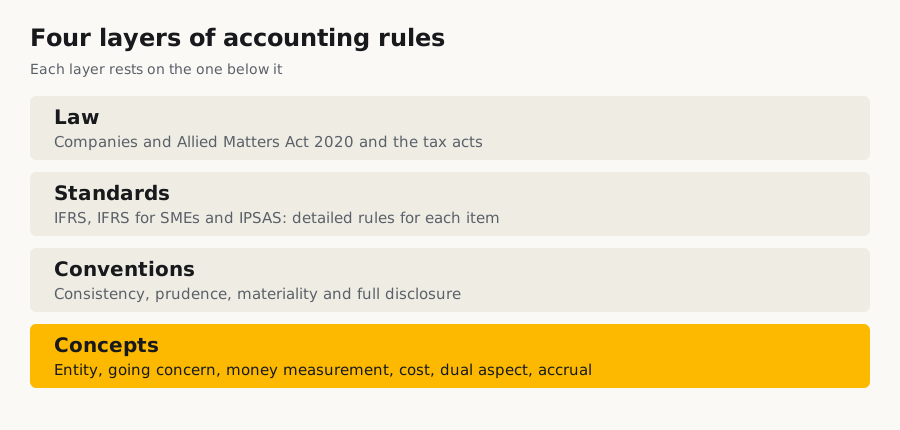
The phrase covers four layers that students often blur:
- Concepts are the basic assumptions, such as treating the business as separate from its owner.
- Conventions are habits of judgement, such as consistency and prudence.
- Standards are detailed rules for specific items, such as inventory or leases.
- Law is the statute that makes some of the rest compulsory, such as the Companies and Allied Matters Act 2020.
Lower layers feed the higher ones. A standard such as IAS 2 on inventory rests on concepts such as accrual and conventions such as prudence. That is why a beginner who learns the concepts first finds the standards easier later.
The core accounting principles at a glance
Textbooks list between five and twelve principles, depending on the author. The table gives the ones that appear in almost every syllabus, with a plain-language test for each.
| Principle | What it says | Quick test in naira |
|---|---|---|
| Business entity | The business is separate from its owner. | The owner pays ₦50,000 for a family wedding from the shop till. That is drawings, not a business expense. |
| Going concern | Accounts assume the business will keep trading for the foreseeable future. | A bakery with a 5-year lease values its ovens for use, not as scrap. |
| Money measurement | Only items with a money value enter the books. | A loyal customer base earns no entry. A ₦2,000,000 delivery van does. |
| Historical cost | Assets go in at what you paid. | Land bought for ₦8,000,000 stays at that cost even if the street now sells at double. |
| Dual aspect | Every transaction has two equal effects. | Buying stock for cash raises inventory and lowers cash by the same amount. |
| Accrual and matching | Record income and costs when they happen and match costs to the income they earn. | Fuel for December deliveries belongs to December, even if the bill is paid in January. |
| Consistency | Use the same method each period unless there is a good reason to change. | If you depreciate vans on a straight line, do not switch to reducing balance to flatter this year. |
| Prudence | Do not overstate assets or income, or understate liabilities or costs. | A customer owing ₦400,000 has gone silent. Provide for the doubt, do not wait for the loss. |
| Materiality | Include what could change a reader's decision. | A ₦300 stapler is expensed at once. A ₦3,000,000 generator is capitalised. |
Which of these are "concepts" and which are "conventions" is a classic exam trap. The next section settles it.
Accounting concepts and conventions: what is the difference?
Concepts answer the question "what are the ground rules?" Conventions answer "how should judgement work inside those rules?" Business entity, going concern, money measurement, historical cost and dual aspect are concepts. Consistency, prudence, materiality and full disclosure are conventions. Accrual and matching are usually placed with the concepts.
The boundary is not fixed. Different authors file the same idea under different headings, and the IFRS Conceptual Framework itself uses neither word as a heading. It speaks of assumptions and of qualitative characteristics. So in an exam, name the idea, give its meaning and show it on a number. Marks usually follow the application, not the label.
Prudence deserves a note. Older textbooks treated it as a licence to understate profit. The Conceptual Framework revised in 2018 describes prudence as the careful use of judgement under uncertainty, and links it to neutrality, so it is not a reason to hide income. You can read the wording in the IFRS Conceptual Framework.
The accounting equation and double entry in one example
Dual aspect becomes concrete in the accounting equation: assets equal liabilities plus equity. Every transaction changes the equation but never breaks it.
Follow Ngozi, who opens a stationery shop in Enugu:
| Transaction | Assets (₦) | Liabilities (₦) | Equity (₦) |
|---|---|---|---|
| Ngozi pays in capital | 500,000 cash | 0 | 500,000 |
| Buys goods for 200,000 on credit | +200,000 inventory | +200,000 payable | 0 |
| Sells goods costing 80,000 for 130,000 cash | +130,000 cash, -80,000 inventory | 0 | +50,000 profit |
| Pays the supplier 100,000 | -100,000 cash | -100,000 payable | 0 |
| Position after four steps | 650,000 | 100,000 | 550,000 |
Check the result: ₦650,000 equals ₦100,000 plus ₦550,000. Double-entry bookkeeping simply records each of those changes as a debit in one account and a credit in another, so the totals of the two sides always match.

One more habit helps when you practise. After every entry, say aloud which two accounts changed and why. If you cannot name both, the entry is not ready. Students who do this catch most posting errors before an examiner does, and it trains the dual aspect idea into a reflex instead of a rule to memorise.
Accrual basis or cash basis? A worked example
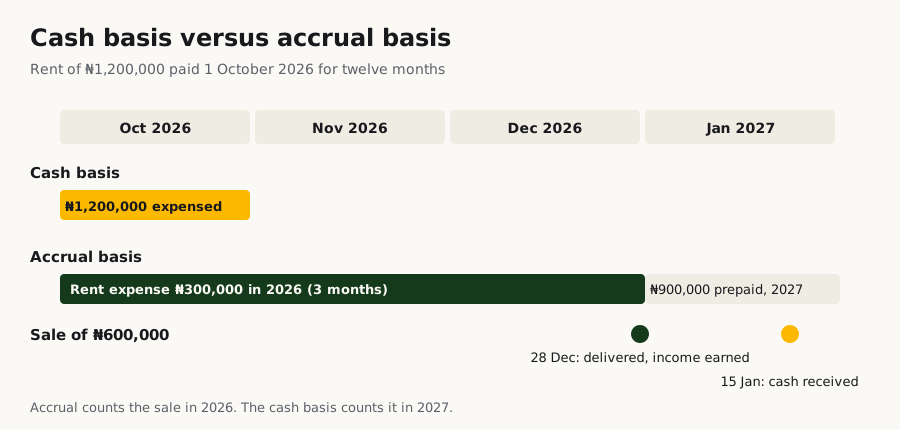
The accrual basis records the effects of transactions when they occur, even if the cash moves in another period. The IFRS Conceptual Framework (paragraph 1.17) describes accrual accounting in exactly those terms. The cash basis records only when money changes hands.
Take a business with a 31 December year end. On 1 October 2026 it pays ₦1,200,000 for twelve months of shop rent. It also delivers goods worth ₦600,000 on 28 December and is paid on 15 January 2027.
| Item for the year to 31 December 2026 | Cash basis (₦) | Accrual basis (₦) |
|---|---|---|
| Sales income | 0 | 600,000 |
| Rent expense | 1,200,000 | 300,000 |
| Prepaid rent carried forward | 0 | 900,000 |
| Profit or (loss) from these two items | (1,200,000) | 300,000 |
Same business, same facts, a swing of ₦1,500,000 in reported profit. The accrual answer is the fairer picture because it matches three months of rent to three months of trading, and it counts a sale the business has already earned. This is why companies must use accrual, and why the matching idea appears in so many exam questions.
What makes financial information useful?
Principles exist to serve users: investors, lenders, regulators, managers and tax authorities. The Conceptual Framework says financial information must be relevant and faithfully represent what it claims to show. Four further qualities lift its usefulness: comparability, verifiability, timeliness and understandability.
These two groups explain many older rules. Consistency supports comparability. Historical cost supports verifiability, because a purchase invoice can be checked. Materiality supports relevance, because clutter hides what matters. When two principles seem to clash, ask which choice gives a reader the better decision.
A short example shows the idea. A trader wants to know whether to extend credit to a new customer. The customer's accounts must be relevant, so they include this year's figures. They must be comparable, so last year's figures sit beside them. They must be understandable, so the notes explain unusual items in plain English. If any one fails, the lender decides on a weaker picture of the business.
Who sets accounting standards in Nigeria?
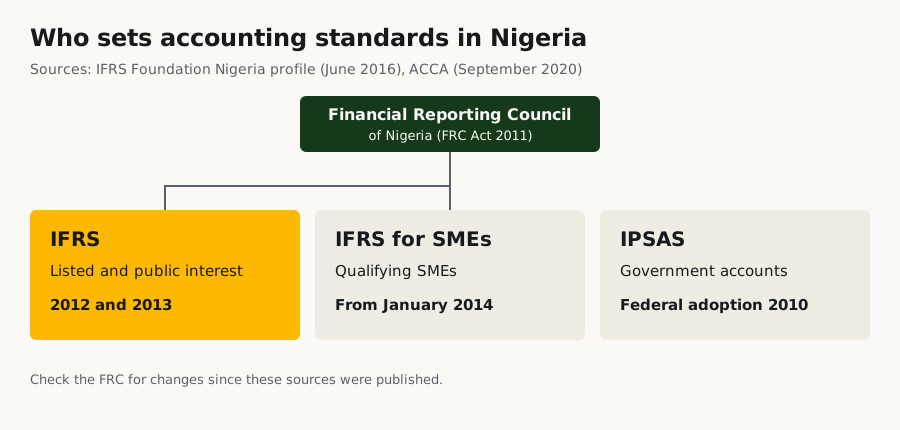
Nigeria uses international standards rather than writing its own for most entities. The table lists who does what. Dates for IFRS come from the IFRS Foundation's Nigeria profile, last updated in June 2016, so check the Financial Reporting Council of Nigeria for later changes.
| Body or instrument | Role | Date |
|---|---|---|
| Federal Executive Council | Approved IFRS adoption with effect from 1 January 2012 | 28 July 2010 |
| Financial Reporting Council of Nigeria (FRC) | Statutory body for reporting standards, set up by the FRC Act 2011 to replace the Nigerian Accounting Standards Board. The FRC notice records that the FRC (Amendment) Act 2023 was signed on 3 May 2023. | 2011 and 2023 |
| IFRS Accounting Standards | Required for listed companies and entities of significant public interest from January 2012, and for other public interest entities from January 2013 | 2012 to 2013 |
| IFRS for SMEs | Applies to qualifying small and medium entities from January 2014. The 2016 profile gave limits of ₦500 million turnover and ₦200 million total assets, or amounts set by the Corporate Affairs Commission | January 2014 |
| IPSAS | Standards for the public sector. The federal government adopted IPSAS in 2010, and accrual IPSAS was meant to be in use across all tiers by the 2020 year end | 2010 to 2020 |
The IPSAS dates come from ACCA's September 2020 report, which noted that most Nigerian public bodies were still reporting on a cash basis. That was the position then. Progress since is a matter for the Office of the Accountant-General.
The IFRS dates above are confirmed in the IFRS Foundation profile for Nigeria. The law that makes accounts compulsory for companies is the Companies and Allied Matters Act 2020, and the Nigeria Tax Act 2025 decides how the profit from those accounts is taxed. Keep the two apart: accounting profit and taxable profit are rarely the same figure.
How these principles appear in exams
Examiners test principles in three ways. First, a definition question asks you to state a concept and give an example. Second, a scenario question gives a transaction and asks which concept it breaches. Third, a calculation question quietly depends on a principle, as in the rent example above where accrual decides the answer.
A sound routine is to name the principle, say it in one sentence, then show the effect with figures. Practise it against real questions using the ICAN Foundation Financial Accounting notes, which cover the bookkeeping behind each idea. If you are still choosing where to study, the guide to accounting cut-off marks shows what universities ask of applicants. Once the principles are clear, the guide to the branches of accounting shows where each one is applied.
Common mistakes to avoid
Four slips cost beginners the most marks:
- Mixing owner and business. Personal spending paid from the business account is drawings, never an expense.
- Confusing prudence with pessimism. Prudence asks for caution under uncertainty, not for hiding profit.
- Recording cash instead of events. A sale on credit is income on the day of delivery, not the day of payment.
- Treating market value as the book value. Under historical cost an asset sits at what you paid, less depreciation, unless a standard allows revaluation.
Most of these come from the same root: reading the books as a bank statement. Accounting records events, and cash is only one kind of event.
Accounting principles guides
Each concept below has its own page with naira examples.
Frequently asked questions
What are the basic accounting principles?
The basic accounting principles are business entity, going concern, money measurement, historical cost, dual aspect, accrual and matching, consistency, prudence and materiality. Some books add realisation and periodicity. The names vary by author, but the ideas stay the same across syllabuses and exam boards.
What is the difference between accounting principles and accounting standards?
Principles are broad ideas that guide judgement, such as accrual or prudence. Standards are detailed, numbered rules for particular items, such as IAS 2 on inventory or IFRS 15 on revenue. Standards apply the principles to specific situations and carry legal force through the FRC.
Does Nigeria use GAAP or IFRS?
Nigeria moved from its own Statements of Accounting Standards to IFRS. The Federal Executive Council approved 1 January 2012 as the start date for listed and significant public interest entities. Other public interest entities followed in 2013 and qualifying SMEs from 2014 under IFRS for SMEs.
How many accounting principles are there?
There is no official number. Some authors list five, others ten or twelve, depending on whether they count conventions and assumptions separately. For exams, learn the nine in the table above and be ready to define each one and show it with a figure.
Why is the going concern concept important?
It lets accountants value assets for continued use instead of forced sale. If a business is not expected to continue, accounts are prepared on a different basis, and the notes must say so. Auditors check this assumption, which is why a doubt about it is reported.
Is the accounting equation a principle?
It is the working form of the dual aspect concept. Assets always equal liabilities plus equity, because every asset is financed either by outsiders or by the owner. It is the starting point for double-entry bookkeeping and for the statement of financial position.
Get new articles by email
Exam tips, study guides and the law in plain English. No spam, and you can leave at any time.