Basic accounting principles for beginners
Five basic accounting principles every beginner needs first, explained through one small Kano tailoring shop with naira figures and a one-page cheat sheet.
The five basic accounting principles a beginner should learn first are business entity, going concern, historical cost, accrual and double entry. Together they tell you whose money you are recording, what value to use, which period it belongs to, and how to keep the books balanced. Learn these before you touch any standard or formula.
Meet Amina, who opens a tailoring shop in Kano. After three weeks her cash box holds ₦180,000 less than she started with, yet her notebook says she has made a profit of ₦80,000. Is the shop making money or losing it? Both numbers are correct, and the five principles below explain why.
What are the basic accounting principles?
They are the starting rules every set of accounts follows, from a market stall to a bank. Beginners often face a list of ten or twelve terms and give up. You do not need them all on day one. Five carry most of the weight, and the rest are refinements you can add later.
Accounting also has a vocabulary of its own, so a note on words helps. In this guide a principle means a rule you apply when you record a transaction. The longer list of accounting concepts adds four more ideas, and the accounting principles hub shows how rules, standards and law fit together.
Principle 1: What does the business entity rule mean?
The business is a separate unit from its owner. Amina's books record only what happens to the shop. If she takes ₦25,000 from the till to help pay for a family wedding, the shop has not spent it on business. The books show it as drawings, a withdrawal by the owner that reduces her stake in the business.
The habit to build is simple. Before every entry, ask whether the item belongs to the business or to the person. Beginners who skip that question mix household and shop spending, and then cannot tell what the shop earns.
Principle 2: Why does going concern matter?
Accounts assume the business will keep trading. That is why Amina's sewing machine is shown as a working tool and not as scrap metal. Under IFRS, accounts are prepared on this basis unless management plans to close the business or has no realistic alternative, and management must look at least twelve months ahead, according to the IFRS Foundation's going concern material. If the shop were about to close, the machine would be valued at what it would fetch on sale instead.
Principle 3: What is historical cost?
Assets go into the books at the price you paid. Amina bought her machine for ₦180,000, so it is recorded at ₦180,000, even if a dealer would now ask ₦250,000 for the same model. The reason is trust. A receipt can be checked, while an opinion about market value cannot.
Over the years the machine loses value through use, and accountants spread its cost over its life through depreciation. That comes later in your studies. For now, remember that the starting figure is the cost on the receipt.
Principle 4: What is accrual accounting?
Record income and costs when they happen, not when cash moves. In week three, Amina delivers dresses to a boutique for ₦150,000. The boutique will pay next month. On the accrual basis she records the ₦150,000 as income now, because she has earned it, and shows the boutique as owing her that amount.
This explains half of the puzzle in the opening story. Her notebook shows profit because the sale counts, even though the cash has not arrived. The next section explains the rest. If you want the timing rule in detail, see the accrual basis vs cash basis guide.
Principle 5: How does double entry keep the books balanced?
Every transaction has two equal effects. The accounting equation shows it: assets equal liabilities plus capital. Here are Amina's four steps for the month.
| Step | Assets (₦) | Liabilities (₦) | Capital (₦) |
|---|---|---|---|
| Pays in capital | Cash +300,000 | 0 | +300,000 |
| Buys machine for cash | Machine +180,000, cash -180,000 | 0 | 0 |
| Buys fabric on credit | Fabric +70,000 | Owed to supplier +70,000 | 0 |
| Sells dresses on credit | Owed by boutique +150,000, fabric -70,000 | 0 | Profit +80,000 |
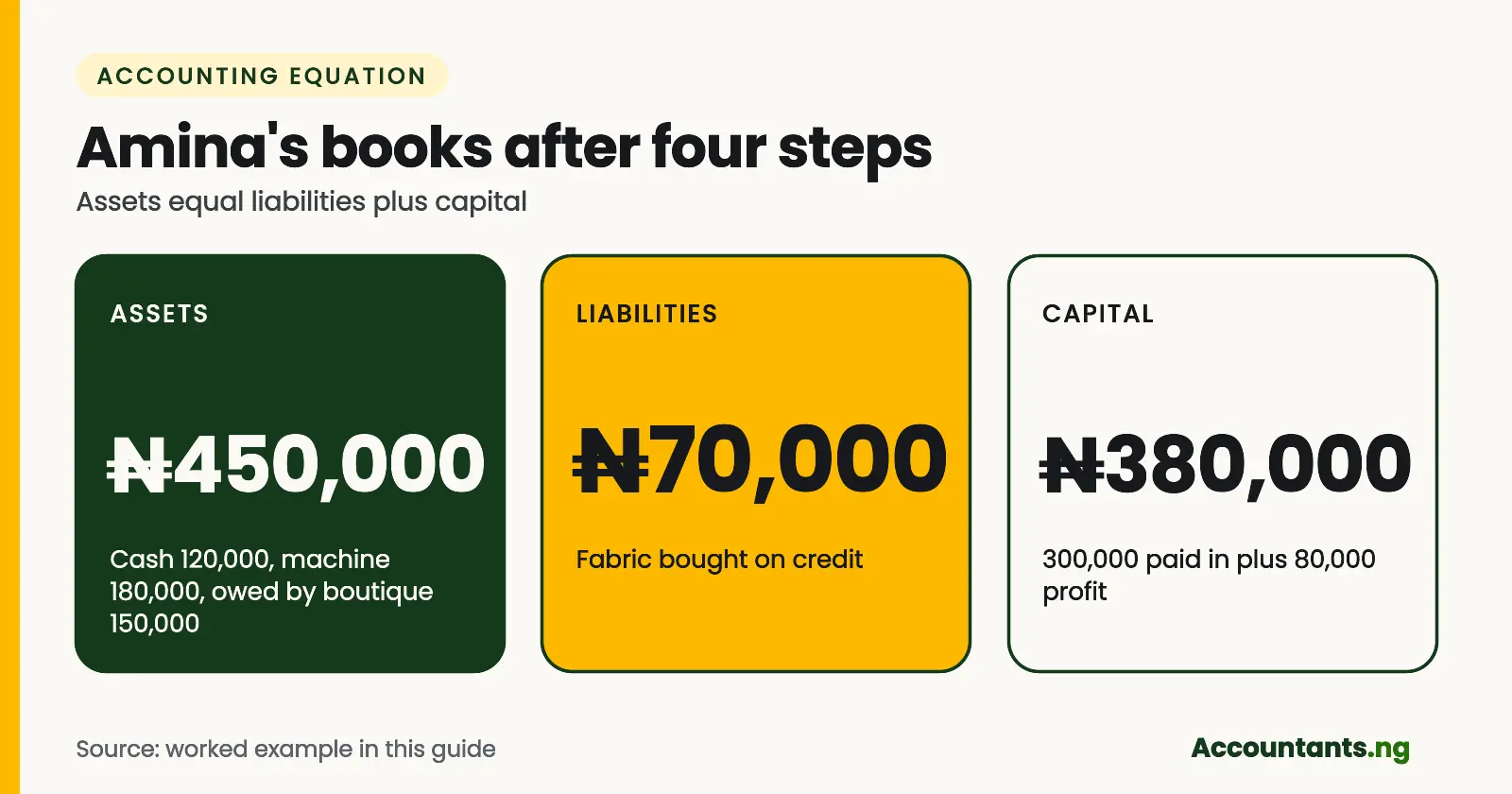
Now add up the position. Assets are cash of ₦120,000, the machine at ₦180,000 and ₦150,000 owed by the boutique, which makes ₦450,000. Liabilities are the ₦70,000 owed to the fabric supplier. Capital is the ₦300,000 she paid in plus the ₦80,000 profit, or ₦380,000. Check: ₦70,000 plus ₦380,000 equals ₦450,000.
The riddle is now solved. Her cash fell by ₦180,000 because the money went into a machine, and a further ₦150,000 sits with a customer. Profit is not cash. It is the difference between what she earned and what it cost her to earn it.
A one-page cheat sheet
Keep this table beside you when you practise. The last column is the question to ask each time.
| Principle | Rule | Ask yourself |
|---|---|---|
| Business entity | Keep owner and business apart | Whose is this? |
| Going concern | Assume the business carries on | Will it keep trading? |
| Historical cost | Record assets at price paid | What is on the receipt? |
| Accrual | Record when earned or incurred | Which period is it for? |
| Double entry | Two equal effects each time | What changed twice? |
When you move on to debits and credits, the usual rule is that increases in assets and expenses are debited, and increases in liabilities, capital and income are credited. Decreases do the opposite. Write that sentence on the first page of your notebook.
Where should a beginner go next?
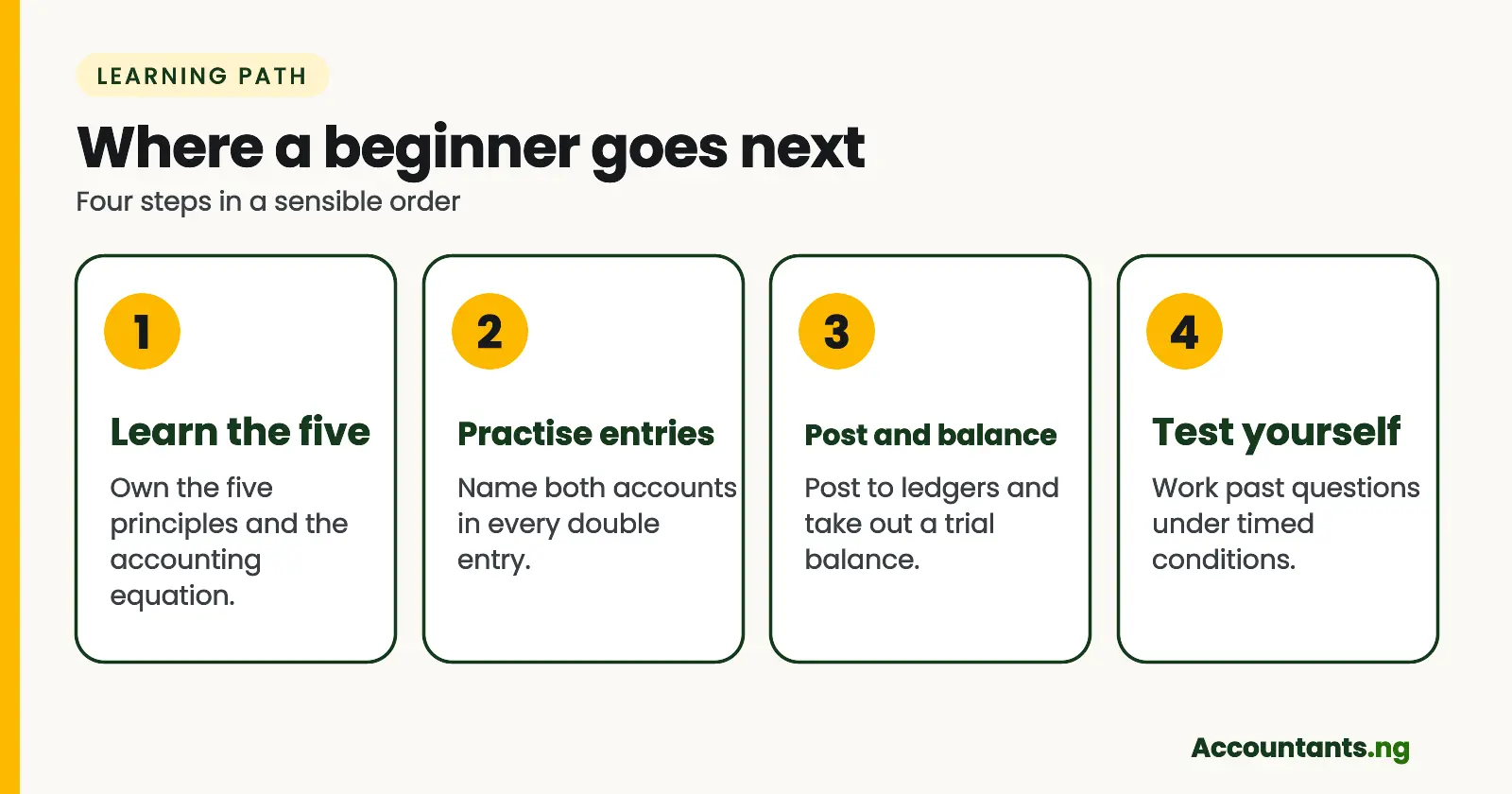
Follow a short path. First, own the five principles above. Second, practise double entry on small examples until you can name both accounts in every entry. Third, learn to post to ledgers and take out a trial balance. Fourth, test yourself on past questions. The ICAN Foundation Financial Accounting notes cover this ground in order, with examples to work through.
On books, there is no single best choice, and you should check your own syllabus before buying anything. Two titles that appear on lists of recommended accounting texts in Nigeria are the ICAN Foundation Level Financial Accounting study text and Frank Wood's Business Accounting. Neither is checked here against a current syllabus, so confirm the edition with your school or tutor. If you are still choosing a degree, the guide to accounting cut-off marks shows what universities ask for.
Common beginner mistakes
- Treating profit as cash. Profit can sit in debtors, stock or equipment, as Amina's did.
- Recording only one side. If you cannot name the second account in an entry, the entry is not ready.
- Mixing personal and business spending. Owner withdrawals are drawings, not expenses.
- Using today's price for an old asset. Use the cost on the receipt unless a standard says otherwise.
Frequently asked questions
What are the 5 basic accounting principles?
This guide uses business entity, going concern, historical cost, accrual and double entry. They answer whose money is recorded, whether the business will continue, what value to use, which period an item belongs to, and how to keep the books in balance. Other books may choose a different five.
What are the 3 basic accounting principles?
There is no official set of three. A short list of three is a teaching shortcut, and tutors choose different ones. Business entity, historical cost and accrual are a sensible trio for a first lesson. Always check which principles your own syllabus or examiner expects before you commit them to memory.
What is basic accounting?
Basic accounting is the process of recording a business's transactions, sorting them into accounts and summarising them into reports such as the profit statement and the statement of financial position. It rests on a few principles, double entry above all, which keep the records accurate and let different people read the same figures the same way.
What is the difference between principles and concepts?
Many authors use the two words as one. Where they separate them, concepts are the underlying assumptions, such as the business entity and going concern ideas, and principles are rules for recording, such as historical cost. Syllabuses vary in what they call each idea, so learn the meaning, not the label.
Is profit the same as cash?
No. Profit is income earned less costs incurred, whenever the cash moves. Cash is money in hand or at the bank. A business can show a profit while its cash falls, for example when it buys equipment or waits for customers to pay, which is exactly what happens to Amina in this guide.
Where do I start learning basic accounting?
Start with the five principles, then practise double entry on small examples using the accounting equation. Next learn ledgers and the trial balance, and finish with past questions. A study text written for your exam body, such as the ICAN Foundation notes, keeps the order sensible and gives worked examples to copy.