Accounting concepts: the complete list with examples
Accounting concepts are the nine basic assumptions behind every set of accounts, and each one is shown here with a naira example from a Nigerian shop.
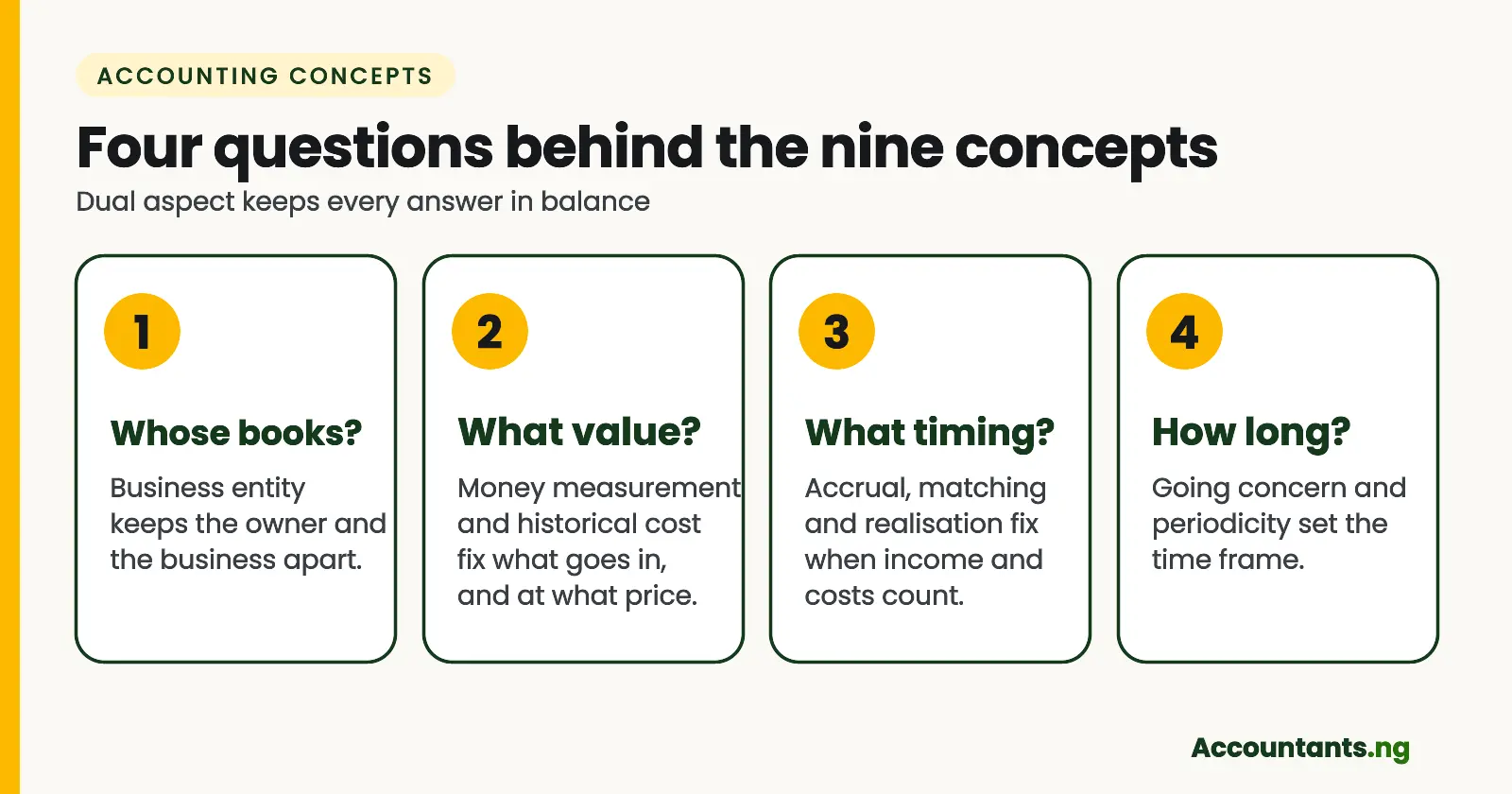
Accounting concepts are the basic assumptions that guide how every business records and reports its transactions. The nine you meet first are business entity, going concern, money measurement, historical cost, dual aspect, accrual, matching, realisation and periodicity. Each one answers a simple question about what to record, when to record it, and at what value.
Picture Chidi Okafor, who sells provisions in Aba. His year ends on 31 December. On 28 December he pays ₦540,000 for a consignment of goods, sells all of it on 29 December for ₦900,000, and gets the money on 12 January. Did he make a profit this year? The answer depends on which concepts you apply, and by the end of this guide you will be able to defend yours with figures.
What are accounting concepts?
Think of them as the ground rules of the game. Before an accountant records anything, the concepts settle whose money it is, how long the business will last, what counts as a record, and which period a transaction belongs to. Without them, two shops with the same facts could report different profits and nobody could tell which one was right.
Concepts sit at the base of a larger structure. Conventions such as consistency and prudence guide judgement inside the concepts, standards such as IAS 2 on inventory give detailed rules for single items, and law makes parts of it compulsory. The guide to accounting principles shows how the four layers fit together. This page stays at the base layer.
Textbooks list more concepts than the IFRS Conceptual Framework spells out by name, and different syllabuses count them differently. The nine below are the ones that appear most often. If your syllabus uses another label for the same idea, learn the idea.
The nine accounting concepts at a glance
| Concept | Plain meaning | Question it answers |
|---|---|---|
| Business entity | The business is separate from its owner | Whose money is it? |
| Going concern | The business will keep trading | How long will it last? |
| Money measurement | Only items with a money value are recorded | What can be recorded? |
| Historical cost | Assets go in at the price paid | At what value? |
| Dual aspect | Every transaction has two equal effects | How do the books balance? |
| Accrual | Record when earned or incurred, not when paid | When is it recorded? |
| Matching | Set costs against the income they earn | Which costs go with which income? |
| Realisation | Revenue counts once it is earned | When is a sale a sale? |
| Periodicity | Split the life of the business into periods | Over what time span? |
The plain meanings follow the unit on accounting concepts in the National Open University of Nigeria course text for ACC 812, which treats each one in the same terms.
What is the business entity concept?
The business is treated as a separate unit from the person who owns it. Its books show only the business's own income, costs, assets and debts. Chidi's family expenses never appear in them.
Suppose Chidi pays ₦40,000 of his daughter's school fees from the shop account. That is not a business expense. It is drawings, a reduction in what the business owes him. A registered company goes further, because in law it is a separate person from its shareholders. The Companies and Allied Matters Act 2020 sets out the rules for companies in Nigeria, but accountants apply the entity concept to sole traders and partnerships too, where the law makes no such split.
What is the going concern concept?
Accounts are prepared on the assumption that the business will carry on trading for the foreseeable future. Under IFRS, financial statements are prepared on a going concern basis unless management intends to liquidate the entity or stop trading, or has no realistic alternative. Management must look at least twelve months ahead from the end of the reporting period, as the IFRS Foundation's going concern material explains for IAS 1 paragraphs 25 and 26.
A date matters here. IFRS 18 applies to reporting periods beginning on or after 1 January 2027 and will replace IAS 1. The going concern requirements move to IAS 8 and stay in force. Nothing about the concept changes for a student sitting an exam today.
The concept affects values. Chidi's freezers cost ₦600,000 and he plans to use them for years, so they sit in the books at cost less depreciation. If he decided to close the shop in two months, the freezers would be valued at what they would fetch on sale, say ₦250,000. The same freezers, a different basis, and a different answer.
How do money measurement and historical cost work?
Money measurement says that only items that can be expressed in naira enter the books. Chidi's delivery motorcycle, bought for ₦1,800,000, is recorded. His loyal customers and good name with suppliers are not, however valuable they are, because nobody can price them reliably.
Historical cost says an asset goes in at the price paid, not at today's market price. Land bought for ₦8,000,000 stays at that figure even if the street now sells at double. The benefit is that a purchase invoice can be checked. The weakness is that old figures lag behind prices in an economy where inflation is high, and the National Open University text notes that fair value is increasingly favoured for this reason. Some standards allow revaluation for certain assets, so check which rule your question applies.
How does dual aspect keep the books balanced?
Every transaction has two sides of equal value. In the accounting equation, assets equal liabilities plus the owner's capital, and each transaction changes the equation without breaking it. Follow Chidi when he starts the business with ₦1,000,000 and buys goods for cash.
| Step | Cash (₦) | Inventory (₦) | Capital (₦) |
|---|---|---|---|
| Pays in capital | 1,000,000 | 0 | 1,000,000 |
| Buys goods for cash | -540,000 | 540,000 | 0 |
| Position after two steps | 460,000 | 540,000 | 1,000,000 |
Check it: cash of ₦460,000 plus inventory of ₦540,000 gives assets of ₦1,000,000, which equals the capital. Double-entry bookkeeping records each side as a debit in one account and a credit in another, so the two totals always agree.
What are accrual, matching and realisation? A worked example
Three concepts decide how much profit a year shows. Accrual says to record income and costs when they happen, whatever the date of the cash. Realisation says revenue is earned when the goods are delivered or the service is done. IFRS 15 asks the same question in its own words: has control passed to the customer? Matching says to put costs in the same period as the income they helped to earn.
Return to Chidi. Besides the goods, he paid ₦240,000 on 1 November for twelve months of shop insurance. At 31 December, only two months of that cover (₦40,000) has been used, and ₦200,000 is a prepayment for next year.
| Year to 31 December | Cash basis (₦) | Accrual basis (₦) |
|---|---|---|
| Sales income | 0 | 900,000 |
| Cost of goods sold | 540,000 | 540,000 |
| Insurance expense | 240,000 | 40,000 |
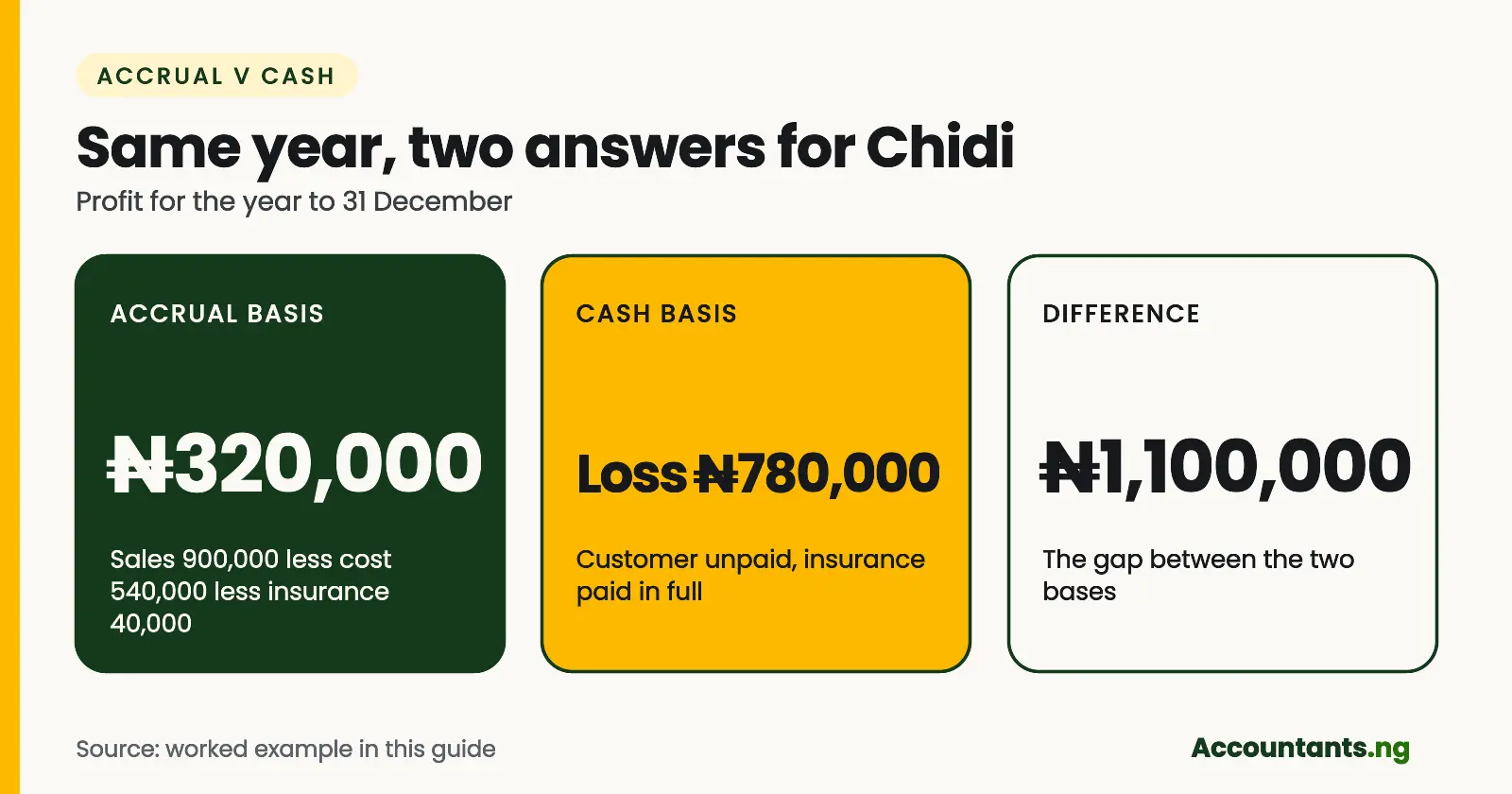
| Profit or (loss) | (780,000) | 320,000 |
On the cash basis Chidi looks like he lost ₦780,000, because the customer has not paid yet and the insurance went out in full. On the accrual basis he made ₦320,000. The sale was realised on 29 December when the goods left the shop. The ₦540,000 cost is matched to the ₦900,000 it earned. Only the ₦40,000 of insurance that belongs to the year is charged. The two answers differ by ₦1,100,000.
What is the periodicity concept?
The life of a business is divided into equal reporting periods, usually twelve months. Without that cut, an owner would learn the true profit only when the business closed. With it, Chidi can compare 2026 with 2025, lenders can see trends, and tax can be worked out on a set period. Periodicity is the reason accruals and prepayments exist at all, since they are the adjustments that put each item in the right year.
Companies in Nigeria prepare financial statements for each financial year under CAMA 2020, so the concept has a legal footing as well as a practical one.
How do exams test accounting concepts?
Three question styles dominate. A definition question asks you to state a concept and give an example. A scenario question describes a transaction and asks which concept it breaks. A calculation question depends on a concept without naming it, as the insurance prepayment above depends on accrual and periodicity.
New to the subject? Start with the basic accounting principles for beginners first, then return here.
A routine that earns marks: name the concept, say it in one sentence, then show the effect with a naira figure. Practise it with the ICAN Foundation Financial Accounting notes. When you want to see where each concept is used in practice, the guide to the types of accounting maps the main branches.
Common mistakes with accounting concepts
- Treating drawings as an expense. Personal spending from the business account reduces capital. It never reaches the profit figure.
- Booking cash instead of events. A sale on credit belongs to the day of delivery, not the day of payment.
- Charging a whole prepayment to one year. Spread it over the periods that use the cover.
- Mixing up accrual and matching. Accrual decides when an item is recorded, and matching decides which income it is set against.
Frequently asked questions
What are accounting concepts?
Accounting concepts are the basic assumptions accountants follow when they record and report transactions. They include business entity, going concern, money measurement, historical cost, dual aspect, accrual, matching, realisation and periodicity. They keep accounts consistent, so two businesses with the same facts report figures that readers can compare.
How many accounting concepts are there?
There is no official number. Course texts list between five and twelve, depending on whether they count conventions such as prudence and consistency. This guide uses nine: business entity, going concern, money measurement, historical cost, dual aspect, accrual, matching, realisation and periodicity. Check your own syllabus for its exact list.
What is the difference between concepts and conventions?
Concepts are the ground rules, such as treating the business as separate from its owner. Conventions guide judgement within those rules, such as applying the same method each year or taking care not to overstate profit. Authors file some ideas under both headings, so learn the meaning rather than the label.
Which concept says a business is separate from its owner?
The business entity concept. It keeps the owner's personal income and spending out of the business accounts. If an owner takes goods or cash for private use, the books record drawings, which reduce the owner's capital, and the amount never counts as a business expense or reduces reported profit.
What happens if the going concern concept no longer applies?
If management intends to liquidate the business or stop trading, or has no realistic alternative, the accounts are no longer prepared on a going concern basis. The notes must say so, give the reasons and name the basis used instead. Assets are then usually valued at what they would fetch on sale.
Is accrual the same as matching?
No. Accrual says to record income and costs when they happen, whatever the date of the cash. Matching says to set each cost against the income it helped to earn in the same period. They work together, which is why textbooks often teach them side by side, but each answers a different question.