Accrual basis vs cash basis of accounting
See how one invented Lagos shop earns a profit on the accrual basis and a loss on the cash basis in the same month, and what that tells you.
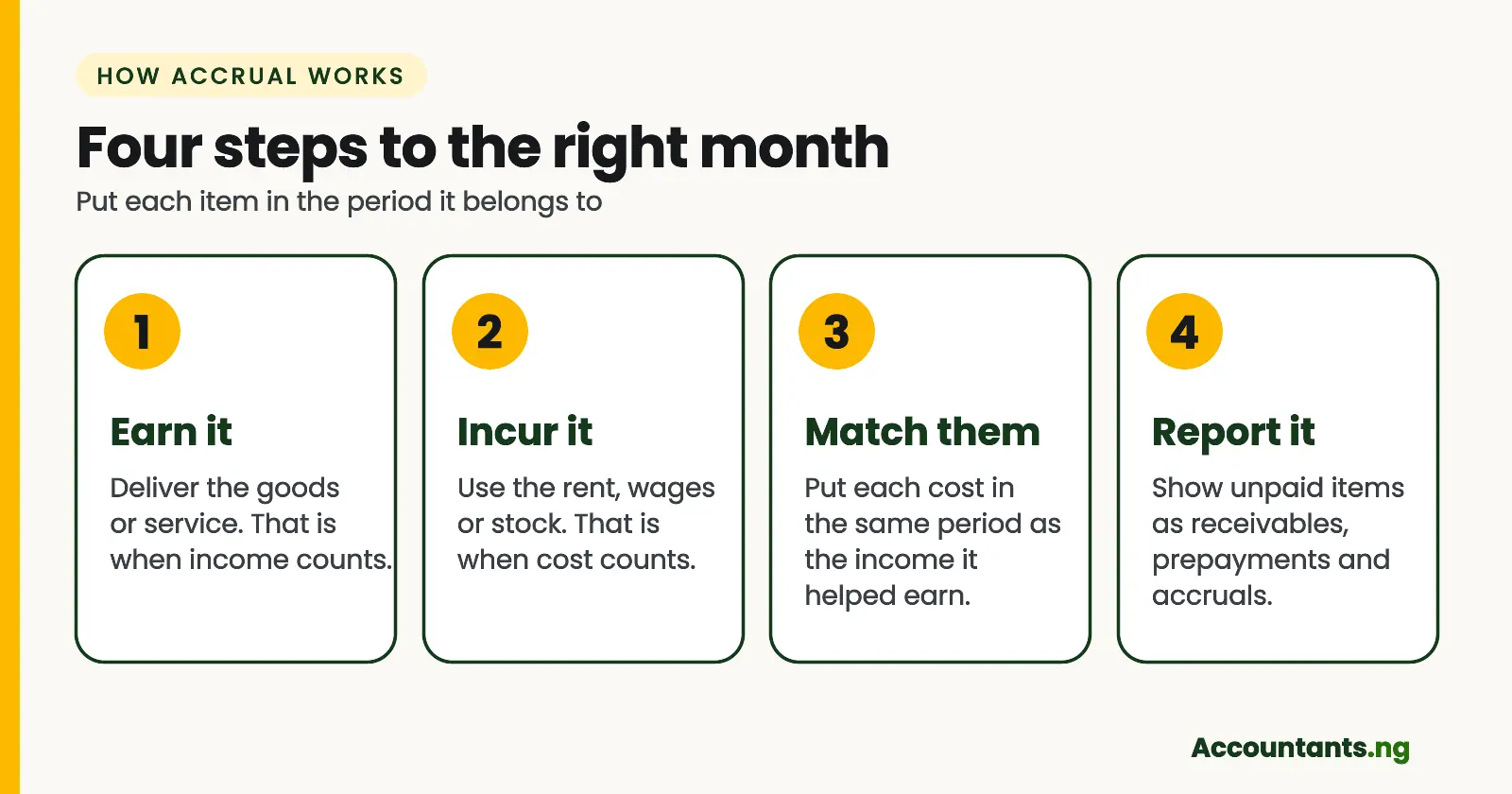
The accrual basis of accounting records income when it is earned and costs when they are incurred, whatever day the cash moves. The cash basis records them only when money is received or paid. Accrual shows what a business earned in a period, while cash shows what came in and went out of the till.
Meet Bisi, who runs a provisions shop in Surulere, Lagos. On 31 October she counts her cash and finds the shop has paid out far more than it took in. A friend who keeps books tells her the shop made ₦240,000 this month. Both numbers are right, and the gap between them is the whole subject of this guide. The shop and all its figures are invented for teaching.
What is the accrual basis of accounting?
It is a rule about timing. A sale belongs to the month you deliver the goods, even if the customer pays later. A cost belongs to the month you use the thing, even if you paid for it earlier or will pay for it later. The test is not whether cash moved, but whether the event happened in this period.
The rule is not a free choice for companies that report under IFRS. A summary of IAS 1 by Moore Global puts it plainly: financial statements are prepared on an accrual basis of accounting, except for cash flow information. Our guide to accounting concepts places the accrual idea alongside the others you will meet in the exam hall.
What is the cash basis of accounting?
Record income when cash arrives and costs when cash leaves. A trader who writes down what goes into and out of a tin is using the cash basis. Its strength is simplicity, because the cash box and the notebook always agree.
Its weakness is what it leaves out. It does not show what customers owe you, what you owe suppliers, or how much of an annual bill has really been used up. As a business grows, those gaps decide whether the figures can be trusted.
How does one month look on each basis?
Four things happen at Bisi's shop in October 2026.
- She sells goods for ₦400,000 in cash.
- She sells goods worth ₦250,000 to a restaurant, which promises to pay on 15 November.
- The goods she sold cost ₦330,000, and she paid the supplier in cash during October.
- On 1 October she pays ₦240,000 for a year's shop rent. Her assistant also earns ₦60,000 for October, which she will pay on 5 November.
Here is the same month recorded both ways.
| Line | Cash basis (₦) | Accrual basis (₦) |
|---|---|---|
| Sales | 400,000 | 650,000 |
| Cost of goods sold | 330,000 | 330,000 |
| Shop rent | 240,000 | 20,000 |
| Assistant's wages | 0 | 60,000 |
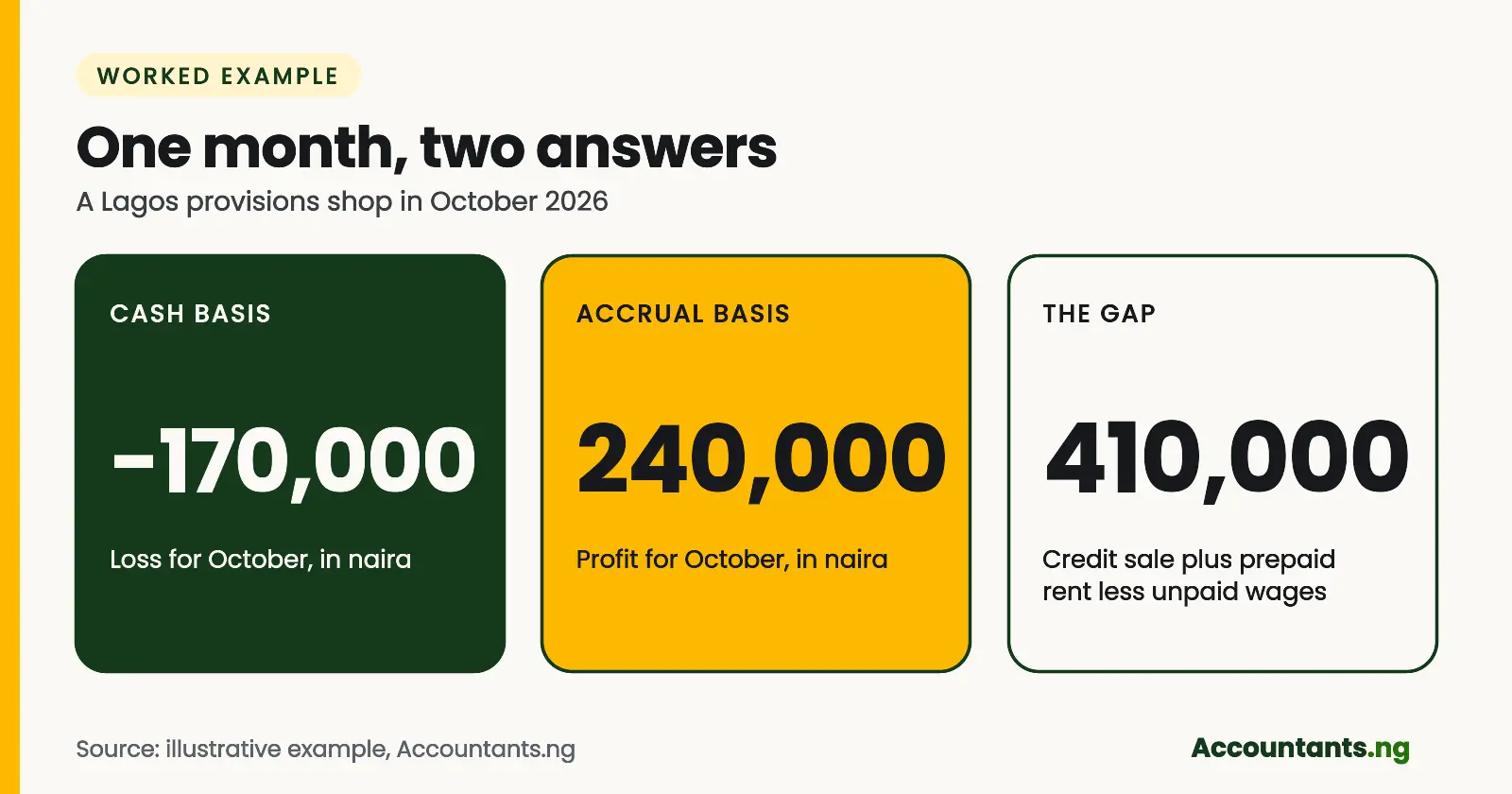
| Result for October | Loss of 170,000 | Profit of 240,000 |
All figures are illustrative.
Why does the same month show a loss and a profit?
Three items explain the whole gap, and each one is a timing difference.
The restaurant sale is income for October, because Bisi delivered the goods. On the cash basis it is invisible until the money arrives. On the accrual basis it adds ₦250,000 to sales and appears on the statement of financial position as an amount owed by a customer, called a receivable.
The rent bill covers twelve months, so October carries only one twelfth, or ₦20,000. The other ₦220,000 is paid in advance. Accountants call it a prepayment and show it as an asset, because the shop has already bought eleven months of premises.
The wages are a cost of October because the assistant worked in October. Bisi has not paid yet, so the accrual basis records ₦60,000 as an accrued expense, a liability she must settle on 5 November.
Now check the arithmetic. Add the restaurant sale of ₦250,000 and the prepaid rent of ₦220,000, then take away the unpaid wages of ₦60,000. The answer is ₦410,000. That is exactly the distance between a ₦170,000 loss and a ₦240,000 profit.
Neither answer is wrong. The cash figure warns Bisi that money is tight until the restaurant pays. The accrual figure tells her the shop traded well. A sensible owner reads both, which is why larger businesses also prepare a cash flow statement next to the profit statement.
Which basis do accounting standards require?
Companies that follow IFRS use the accrual basis, as the IAS 1 wording above shows. The cash basis is mainly a bookkeeping habit of very small traders and, until recently, of many public bodies.
In the public sector the picture is changing. ACCA's Accounting and Business magazine reported in September 2020 that the federal government adopted IPSAS in 2010, that a 2013 National Treasury circular told public bodies to move to accrual IPSAS, and that most were still using the cash basis. The Financial Reporting Council of Nigeria later set out which bodies follow which framework in its statement on public sector reporting. Entities fully funded by government, or drawing up to 80% of funding from it, apply IPSAS. Commercial public entities and incorporated government bodies apply IFRS.
A current count of public bodies reporting on accrual IPSAS is not yet published in the sources checked on 10 November 2026, so this guide gives no figure.
Which basis should a small trader use?
A sole trader's private notebook can sit on the cash basis, and many do. The picture changes when you borrow from a bank, bring in a partner, or prepare accounts under company law. Those readers expect accrual figures, because they want to know what the business owes and is owed.
Tax filing has its own rules, so ask a qualified accountant or the tax authority before you choose a basis for tax. This guide does not give tax advice.
For ICAN Foundation papers, examiners expect you to adjust a trial balance for prepayments and accruals. The Financial Accounting notes work through those adjustments step by step.
Common mistakes with accrual and cash
- Treating the cash balance as profit. Cash can fall in a profitable month, as it did at Bisi's shop.
- Expensing a whole annual bill at once. Only the part used this period is a cost; the rest is a prepayment.
- Ignoring unpaid bills. Wages and electricity for the month belong in the month, paid or not.
- Recording a sale only when paid. Delivered goods are income, with a receivable until the customer pays.
If you are new to the vocabulary, start with the basic accounting principles and then return here. To see how every entry keeps the books in balance, read the accounting equation with ten worked transactions. The accounting principles hub shows where accrual sits among the rest.
Frequently asked questions
What is the accrual basis of accounting?
It is a method that records income when it is earned and costs when they are incurred, whether or not cash has moved. A sale made on credit counts as income straight away, and an unpaid electricity bill counts as a cost. This gives a truer picture of performance in each period than cash records alone.
What is the difference between accrual and cash basis accounting?
The difference is timing. The cash basis records income and costs on the day money is received or paid. The accrual basis records them in the period they relate to. In the Lagos shop above, the same October gives a loss of ₦170,000 on the cash basis and a profit of ₦240,000 on the accrual basis.
Which is better, accrual or cash basis?
Neither is better for every business. The cash basis is simpler and suits very small traders who want to track the cash box. The accrual basis gives a fuller picture of performance and debts, and it is what IFRS reporting companies use. Most growing businesses move to accrual because lenders and investors expect it.
Is accrual accounting required by law in Nigeria?
This guide did not confirm one law that covers every business. Companies reporting under IFRS must use the accrual basis. Public bodies are being moved to accrual IPSAS, according to the FRC and ACCA sources above. For your own situation, including tax, ask a qualified accountant, because the answer depends on who you are and what you file.
What is an accrued expense?
An accrued expense is a cost that has been incurred but not yet paid at the end of the period. In the example above, the assistant's October wages of ₦60,000 are paid on 5 November. They are still a cost of October, and they appear as a liability on 31 October until Bisi settles them.
What is a prepayment in accounting?
A prepayment is a cost paid before the period it relates to. Bisi paid ₦240,000 for twelve months of rent on 1 October. October bears ₦20,000 of it, and the other ₦220,000 is shown as an asset because the shop has already paid for eleven further months of use.