The accounting equation: formula, examples and exercises
Work ten naira transactions through the accounting equation for one invented Aba shop, then test yourself with five practice questions and answers.

The accounting equation says that assets equal liabilities plus capital. Assets are what a business owns, liabilities are what it owes to outsiders, and capital is what is left for the owner. Every transaction changes at least two items, so the equation always balances. This guide works ten transactions through it and ends with five practice questions.
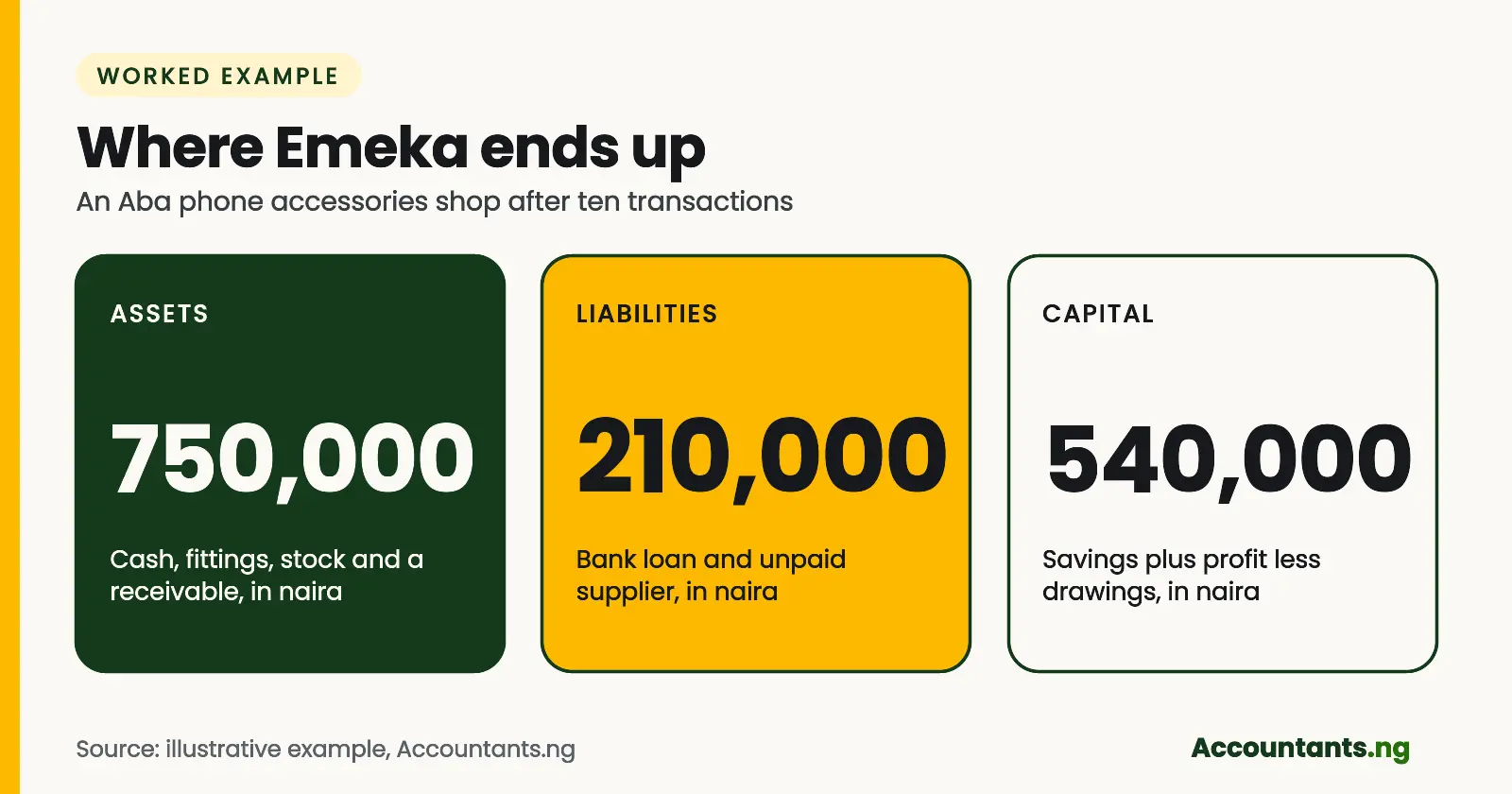
Emeka opens a phone accessories shop in Aba with savings of ₦500,000. Ten transactions later he owns ₦750,000 of things, owes ₦210,000, and yet his own stake is ₦540,000, which is more than he started with. Where did the extra ₦40,000 come from, and why do the books still balance to the naira? The shop and its figures are invented for teaching.
What is the accounting equation?
It is one line that holds for every business, from a market stall to a bank. In its usual form it reads:
Assets = Liabilities + Capital
You can rearrange it. Capital equals assets minus liabilities, which is how an owner finds out what the business is worth to them. ACCA's technical article on the accounting equation describes capital as the owners' residual interest in the business after liabilities are deducted, and notes that for a limited company it is called equity.
What do assets, liabilities and capital mean?
An asset is a resource the business controls, such as cash, stock, a shop fitting or money a customer owes. The Conceptual Framework behind IFRS defines it as a present economic resource controlled by the entity as a result of past events. A liability is a present obligation to transfer an economic resource as a result of past events, such as a bank loan or an unpaid supplier.
Capital, or equity, is the owner's claim. It grows when the owner pays in money and when the business makes a profit. It shrinks when the business makes a loss or when the owner takes money out for personal use, which accountants call drawings.
How do ten transactions change the equation?
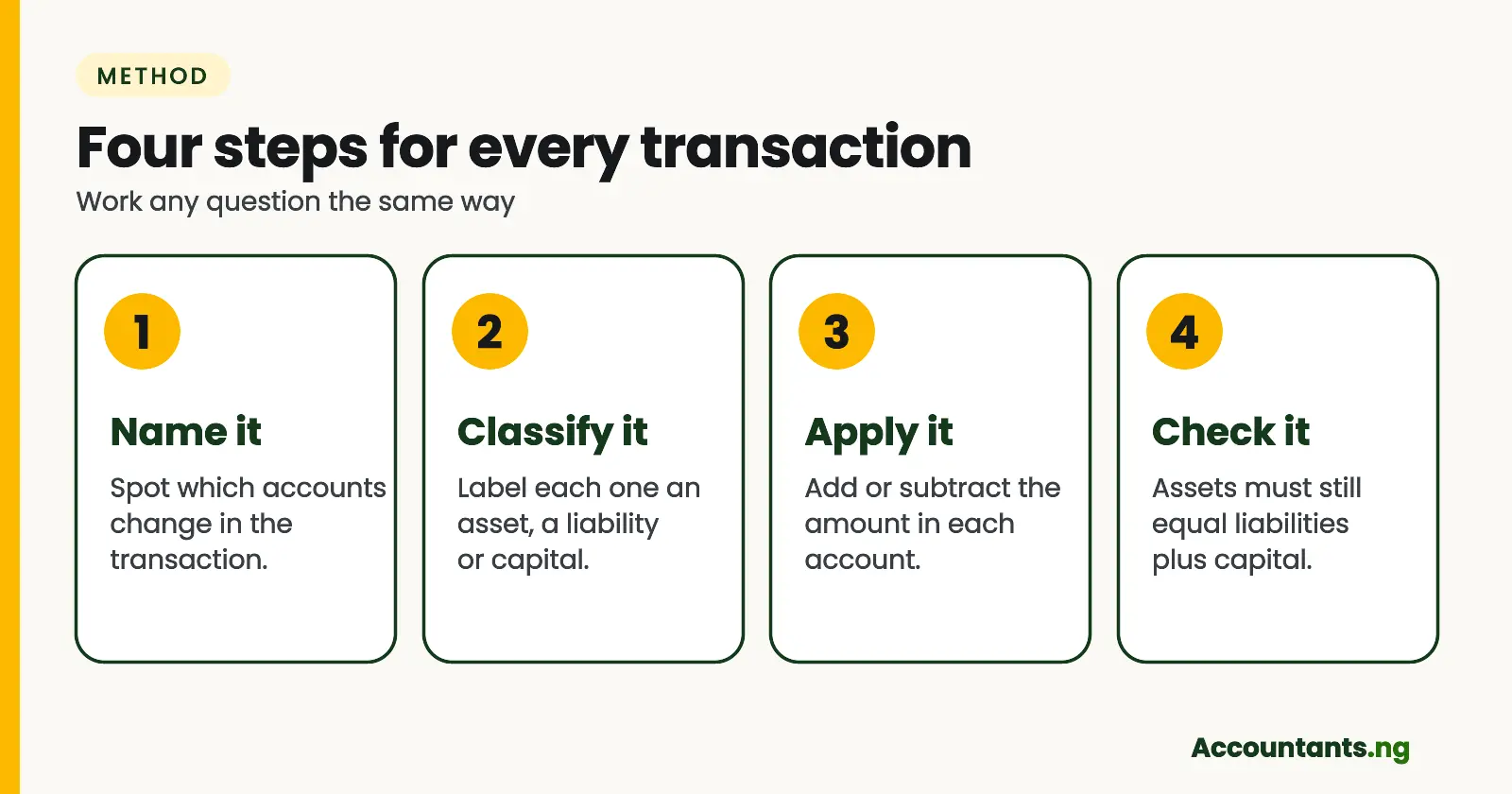
Follow Emeka line by line. For each transaction, ask which accounts change and whether each is an asset, a liability or capital.
| No. | What happens | Effect on the equation |
|---|---|---|
| 1 | Pays in ₦500,000 of savings | Cash +500,000, capital +500,000 |
| 2 | Borrows ₦200,000 from a bank | Cash +200,000, loan +200,000 |
| 3 | Buys fittings for ₦150,000 cash | Fittings +150,000, cash -150,000 |
| 4 | Buys phone cases on credit, ₦120,000 | Stock +120,000, payables +120,000 |
| 5 | Sells cases costing ₦40,000 for ₦90,000 cash | Cash +90,000, stock -40,000, capital +50,000 |
| 6 | Pays ₦30,000 rent in cash | Cash -30,000, capital -30,000 |
| 7 | Pays supplier ₦60,000 | Cash -60,000, payables -60,000 |
| 8 | Takes ₦20,000 cash for home use | Cash -20,000, capital -20,000 |
| 9 | Sells cases costing ₦30,000 on credit for ₦70,000 | Receivable +70,000, stock -30,000, capital +40,000 |
| 10 | Repays ₦50,000 of the loan | Cash -50,000, loan -50,000 |
Now keep a running total after each step. Every row must balance before you move on.
| After step | Assets (₦) | Liabilities (₦) | Capital (₦) |
|---|---|---|---|
| 1 | 500,000 | 0 | 500,000 |
| 2 | 700,000 | 200,000 | 500,000 |
| 3 | 700,000 | 200,000 | 500,000 |
| 4 | 820,000 | 320,000 | 500,000 |
| 5 | 870,000 | 320,000 | 550,000 |
| 6 | 840,000 | 320,000 | 520,000 |
| 7 | 780,000 | 260,000 | 520,000 |
| 8 | 760,000 | 260,000 | 500,000 |
| 9 | 800,000 | 260,000 | 540,000 |
| 10 | 750,000 | 210,000 | 540,000 |
All figures are illustrative.
Why does the equation always balance?
Because every transaction has two sides, and the two sides are always equal. Look back at the table and you will see only three patterns.
First, both sides rise or fall together. Steps 1, 2, 4 and 7 are of this kind. When Emeka borrows, his assets and his liabilities both grow by ₦200,000.
Second, one asset swaps for another, so the total does not move. In step 3 cash becomes fittings, and in step 10 repaying the loan shrinks cash and the loan together.
Third, capital moves through profit and drawings. Step 5 is the peak of the exercise. Emeka hands over stock that cost ₦40,000 and gets ₦90,000 in cash. Assets rise by ₦50,000 net, and capital rises by the same ₦50,000, because that is his profit on the sale. The extra ₦40,000 in his stake at the end comes from the same source, as the next section shows.
What is the expanded accounting equation?
The expanded form opens up capital so you can see where it came from:
Assets = Liabilities + Capital introduced + Income - Expenses - Drawings
Apply it to Emeka. Income is the two sales, ₦90,000 plus ₦70,000, which is ₦160,000. Expenses are the cost of the goods sold, ₦40,000 plus ₦30,000, and the rent of ₦30,000, which is ₦100,000. Profit is therefore ₦60,000. Capital at the end is ₦500,000 paid in, plus ₦60,000 profit, less ₦20,000 drawings, which is ₦540,000. The assets of ₦750,000 equal liabilities of ₦210,000 plus capital of ₦540,000.
That answers the opening puzzle. His stake rose by ₦40,000 because a profit of ₦60,000 more than covered the ₦20,000 he took home.
Can you test yourself on the accounting equation?
Try these five before reading the answers.
- A business has assets of ₦900,000 and liabilities of ₦350,000. What is capital?
- Capital is ₦400,000 and liabilities are ₦150,000. What are the assets?
- A trader buys a generator for ₦180,000 on credit. How does the equation change?
- Opening capital is ₦300,000. During the year profit is ₦120,000 and drawings are ₦45,000. What is closing capital?
- A customer pays ₦25,000 owed from an earlier credit sale. What happens to total assets?
Answers.
- Capital is ₦550,000, because 900,000 less 350,000 leaves 550,000.
- Assets are ₦550,000, because 400,000 plus 150,000 gives 550,000.
- Assets rise by ₦180,000 for the generator, and liabilities rise by ₦180,000 for the amount owed. Capital does not change.
- Closing capital is ₦375,000, because 300,000 plus 120,000 less 45,000 gives 375,000.
- Total assets do not change. Cash rises by ₦25,000 and the receivable falls by ₦25,000.
Where does the accounting equation lead next?
The equation is the working form of double entry, the rule that every transaction has two equal effects. The guide to basic accounting principles shows the same idea through a tailoring shop. The guide to accrual basis vs cash basis explains why Emeka's credit sale in step 9 counts as income before the cash arrives, and the accounting principles hub links the rest.
For exam practice, the ICAN Foundation Financial Accounting notes build on this equation with ledgers and the trial balance.
Common mistakes with the accounting equation
- Counting drawings as an expense. Money the owner takes home reduces capital directly and never enters the profit figure.
- Forgetting the second effect. If you cannot name the account on the other side, the entry is not finished.
- Mixing up a swap and a rise. Paying a supplier cuts cash and payables together. Buying stock on credit raises stock and payables together.
- Treating profit as cash. In step 9 Emeka books a profit of ₦40,000 on a sale that has not yet been paid for.
Frequently asked questions
What is the accounting equation?
The accounting equation states that assets equal liabilities plus capital. Assets are what the business owns, liabilities are what it owes to outsiders, and capital is the owner's remaining claim. It holds after every transaction, because each transaction has two equal effects, which is why the books of every business stay in balance.
What is the accounting equation formula?
The basic formula is Assets = Liabilities + Capital. Rearranged, Capital = Assets - Liabilities. The expanded form is Assets = Liabilities + Capital introduced + Income - Expenses - Drawings. For a limited company, the word equity replaces capital. Use whichever form helps you find the missing figure in a question.
Can the accounting equation be wrong?
The equation itself always holds, but your records can be wrong while still balancing. If you record a ₦20,000 expense as ₦2,000 on both sides, the totals match and the figures are still wrong. Balancing proves the arithmetic of the two sides, not that each amount, account or period is correct.
How do drawings affect the accounting equation?
Drawings reduce both assets and capital. When Emeka takes ₦20,000 in cash for home use, cash falls by ₦20,000 and his capital falls by the same amount. Drawings are not an expense of the business. They are a withdrawal by the owner, so they never appear in the profit figure.
Does profit change the accounting equation?
Yes, profit increases capital. When a business sells goods for more than they cost, assets rise by the margin and capital rises by the same amount. A loss does the opposite. At the end of a year, the profit or loss is added to or taken from the owner's capital.
Is the accounting equation the same as double entry?
They are closely linked. Double entry is the rule that every transaction affects two accounts by equal amounts. The accounting equation is the result you can check, because those equal effects keep assets equal to liabilities plus capital. Learn the equation first, and debits and credits will make more sense.