CAMA 2020 Minimum Share Capital: ₦100,000 and ₦2,000,000
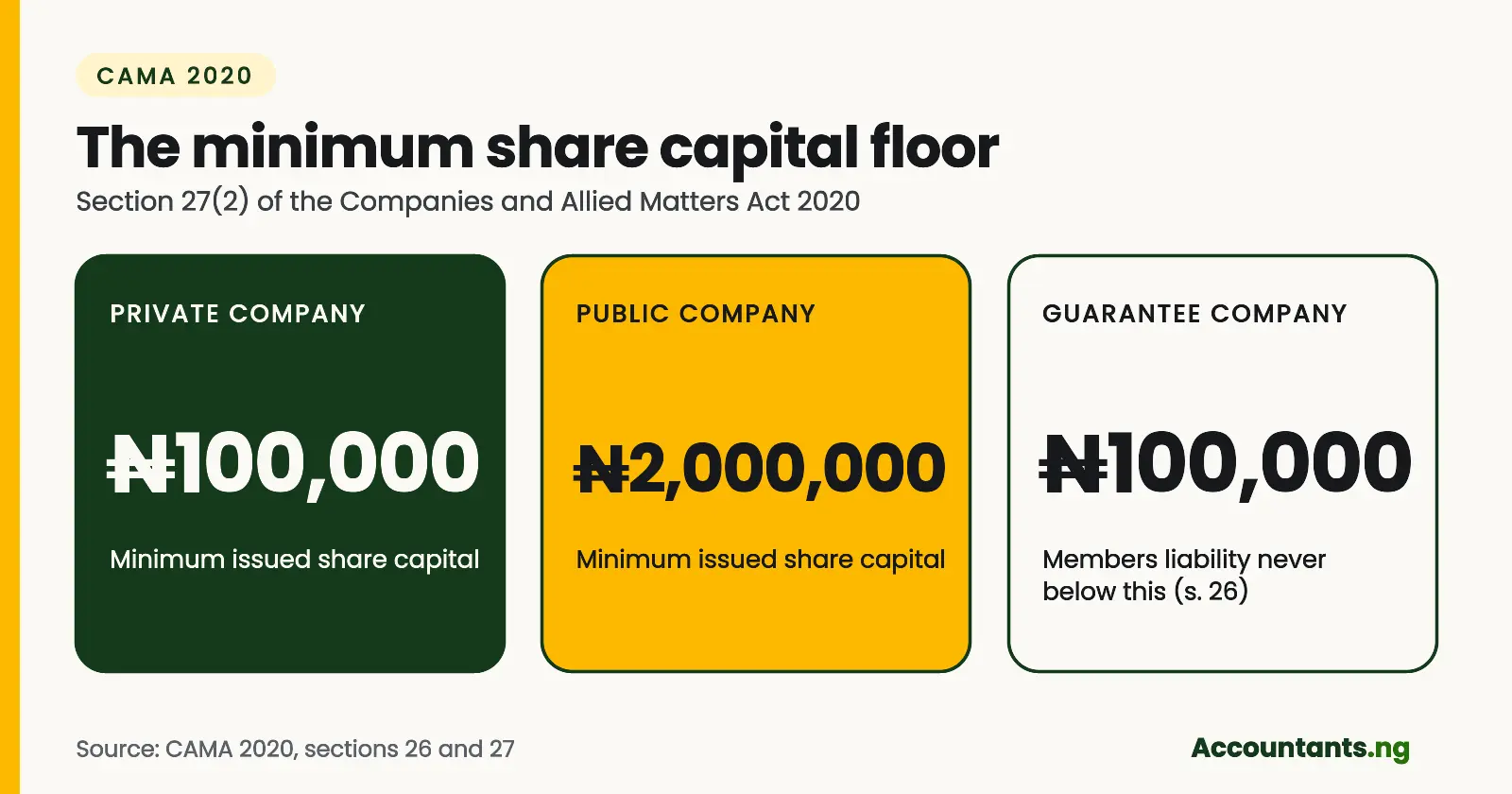
Section 27(2)(a) of CAMA 2020 fixes the minimum issued share capital at ₦100,000 for a private company and ₦2,000,000 for a public one; this guide quotes the wording and shows where the floor applies.

The CAMA 2020 minimum share capital is ₦100,000 for a private company and ₦2,000,000 for a public company. Section 27(2)(a) fixes both as floors, not ceilings. Yet in December 2023 a CAC public notice briefly asked foreign-owned companies for ₦100 million, and many people took it for law. It was withdrawn within days.
So which figure binds you? A wrong one risks a memorandum the CAC cannot register, or lost marks in a company law paper. We read the Act on this site, then checked law-firm notes, CAC pages and the Central Bank of Nigeria (CBN) circular. Every source was checked on 8 November 2026.
What does section 27(2) say, word for word?
Here is the text of section 27(2), with the naira sign shown as ₦. Where the company has share capital, it reads:
“(a) the memorandum of association shall also state the amount of the minimum issued share capital which shall not be less than ₦100,000.00 in the case of a private company and ₦2,000,000.00, in the case of a public company, with which the company proposes to be registered, and the division thereof into shares of a fixed amount; and (b) each subscriber shall write opposite his name the number of shares he takes.”
Three words carry the weight. Minimum makes the figures floors, not ceilings. Issued is the test, and issued does not mean fully paid: section 37(1)(d) has the statement of initial issued share capital show the amount to be paid up and the amount, if any, left unpaid on each share. Proposes means the figure is what the subscribers say the company will start with.
Section 868 closes the loop. It defines “minimum issued share capital” as the respective amounts stated in section 27(2)(a).
Which section sets which rule?
The two figures reach well beyond section 27. Seven provisions of the Act apply them:
| Section | Rule | Effect |
|---|---|---|
| 18(2) | One person may form a private company | One founder can meet ₦100,000 |
| 25 | Unlimited company: capital not below the s. 27(2) minimum | Same floors apply |
| 26(12) | Guarantee members' total liability never below ₦100,000 | No shares, still a floor |
| 27(2)(a) | Memorandum states minimum issued capital | ₦100,000 or ₦2,000,000 |
| 57(1)(a), (b) | Re-registering as public | Capital at least ₦2,000,000, one-quarter paid up |
| 124(2), (4) | No registration below, and never below | Floor applies for life |
| 133(1)(b) | Court confirms a reduction only above the floor | Cuts stop at the minimum |
Does the minimum stop mattering after registration?
No, and this is where most summaries stop too early. Section 124(4) says: “where a company is registered with shares, its issued capital shall not at any time be less than the minimum issued share capital.” Section 124(5) adds a fine, and a daily default fine, in amounts the CAC sets by regulation. We quote no amount because we found no dated figure.
Two worked examples show the floor in action. Both are illustrations, not real companies.
A reduction. Adaeze Foods Ltd is private, with issued capital of ₦3,000,000. It wants to cut that to ₦50,000 and return cash. It needs authority in its articles, a special resolution and the court's confirmation (section 131(1)). The court may confirm only if capital does not fall below the minimum (section 133(1)(b)). So the lowest it can ask for is ₦100,000, and the most it can return is ₦2,900,000.
Going public. Kano Plastics Ltd is private, with ₦5,000,000 issued. Section 57(1)(a) wants allotted capital of at least ₦2,000,000, which it has. Section 57(1)(b) wants each allotted share at least one-quarter paid up, plus the whole of any premium. On ₦5,000,000 that is ₦1,250,000. If it has paid up ₦1,000,000, it is ₦250,000 short. Section 57 adds conditions for shares issued for services or non-cash consideration.
How do you raise capital above the floor?
Registering at the minimum is only the start. Under section 127, a company raises issued share capital by ordinary resolution in general meeting, notifies the CAC within 15 days of the resolution, and amends its memorandum and articles. A private company moving from ₦100,000 to ₦1,000,000 follows exactly that path. Our guide to increasing and reducing share capital covers each step.
Filing fees are not in the Act. Section 37(4) leaves them to the Minister. A law-firm note by Moroom Africa Legal Consults (25 June 2025) reports a new CAC fee schedule effective 1 August 2025. It puts the private company incorporation fee at ₦10,000 for issued capital up to ₦1,000,000, a band that covers the ₦100,000 floor. We could not confirm a dated public company figure. We also found no officially published stamp duty figure, although section 27(6) requires the memorandum to be stamped as a deed.
Does a foreign owner need ₦100 million?
Not under CAMA. On 5 December 2023 the CAC issued a notice asking for fully paid-up share capital of ₦100,000,000 at incorporation for companies with foreign participation. Aluko & Oyebode (8 December 2023) reports that the figure came from the Ministry of Interior's Revised Handbook on Expatriate Quota Administration 2022, and that the Act had not been amended to support it. The CAC then reversed the notice and promised a revised one.
We found no replacement notice in the sources we read. If any shareholder is foreign, check the Ministry of Interior's current rules as well as section 27. The company law floor and the immigration requirement are different tests.
Has anything else changed since 2020?
We found no amendment, CAC notice or regulation that changes the two figures in section 27(2)(a) as at 8 November 2026. The Companies Regulations 2021 did stir debate, but about unissued shares. TNP's note on Legal 500 (12 May 2021) says Regulation 13 required existing companies to allot all their unissued shares, while CAMA 2020 does not. That dispute never touched the floors.
Do banks and insurers have higher minimums?
Yes, because sector laws and regulators set their own. CAMA's ₦100,000 and ₦2,000,000 are the general company law floor. For banks, the CBN circular of 28 March 2024 set these minimums, with a deadline of 31 March 2026. We have not checked which banks met it.
| Licence | Minimum capital | Deadline | Source |
|---|---|---|---|
| International commercial bank | ₦500 billion | 31 March 2026 | Nairametrics |
| National commercial bank | ₦200 billion | 31 March 2026 | Same report |
| Merchant bank | ₦50 billion | 31 March 2026 | Same report |
Insurers have their own law and figures. We have not verified them, so we show none.
Which mistakes cost the most?
- Treating ₦100 million as the general rule. It was a withdrawn notice for foreign participation, not section 27.
- Treating the minimum as a ceiling. It is the lowest figure you may state.
- Stating share capital for a company limited by guarantee. It has none; section 26(12) sets a liability floor instead.
- Skipping the formalities. A subscriber holding shares in trust must name the beneficiary (section 27(3)), and the memorandum needs a witness and a stamp (section 27(5) and (6)).
How do you use this in an exam answer?
Give the figure and the section together, so the marker sees the source. For example: a private company needs minimum issued share capital of ₦100,000 under section 27(2)(a) of CAMA 2020. Then add the rule that earns the extra mark, such as section 124(4) or section 133(1)(b). Our Corporate and Business Law notes and the full CAMA 2020 text help you practise.
The floor is small, but the Act bars registration below it and fines a company that slips under it later. Know the figure, and know where it bites.
Frequently asked questions
What is the minimum share capital for a private company in Nigeria?
Section 27(2)(a) of CAMA 2020 requires the memorandum of a private company with share capital to state minimum issued share capital of at least ₦100,000. That figure is a floor, so a company may register with more. Section 124(4) says issued capital must not fall below the minimum at any time.
What is the minimum share capital for a public company?
A public company must state minimum issued share capital of at least ₦2,000,000 under section 27(2)(a). To re-register a private company as public, section 57(1) also asks that allotted capital meet that minimum and that each allotted share be at least one-quarter paid up, plus the whole of any premium.
Can one person form a company with ₦100,000?
Yes. Section 18(2) lets one person form and incorporate a private company, and the private company floor is ₦100,000 under section 27(2)(a). The founder writes the number of shares taken opposite their name in the memorandum, discloses any trust, and signs before at least one witness.
Must the full ₦100,000 be paid up at registration?
The sections we read set no paid-up minimum for a private company at formation. Section 37(1)(d) requires the statement of initial issued share capital to show the amount to be paid up and any amount unpaid on each share. Ask the CAC about its current filing practice before you file.
Do foreign-owned companies need ₦100 million?
Not under CAMA. A CAC notice of 5 December 2023 sought ₦100 million fully paid-up capital for companies with foreign participation, based on a Ministry of Interior handbook, and the CAC reversed it. We found no replacement notice, so confirm the current immigration and CAC position before you incorporate.
Can a company reduce its capital below the minimum?
No. Under section 133(1)(b) the court may confirm a reduction only if the share capital does not fall below the minimum issued share capital. The company also needs authority in its articles and a special resolution under section 131(1), and creditors may object under section 132.
Read section 27 of CAMA 2020 before you sign your memorandum.
Keep reading

JAMB subject combination for accounting: 20 top universities
The JAMB subject combination for accounting, and the fourth-subject rule at 10 top public and 10 top private universities, checked against the brochure.
9 Nov 2026 8 min read
Accounting Cut-Off Marks for Nigerian Universities (2026)
The 2026 JAMB floor, each university minimum UTME score and the UNILAG Accounting merit figure, with a source beside every number.
7 Nov 2026 9 min read
32 VAT Exempted & Zero-rated Goods & Services in Nigeria
All 17 zero-rated and 15 exempt goods and services under the Nigeria Tax Act 2025, and what the difference costs a seller in input...
7 Nov 2026 9 min readGet new articles by email
Exam tips, study guides and the law in plain English. No spam, and you can leave at any time.