ICAN Past Questions: How to Revise With Them
Reading a topic shows what you recognise, so use this five-step method with real ICAN questions and marking guides to practise what you can write.

ICAN past questions are the best revision tool because they test what the exam pays for: producing answers, not recognising notes. Finish the topic, attempt a paper against the clock, mark yourself against ICAN's guide, fix the cause of each lost mark, then repeat the question a week later.
ICAN's marking guide for Question 1 of the May 2026 Management Accounting paper pays 8 marks for 16 ticks in the FIFO ledger, 8 for 16 in the LIFO ledger and 4 for 8 in the operating statement. About 75% of candidates attempted it and about 70% scored 50% or more. Yet the examiner still flagged one part as a weak spot. Which one, and why?
The answer shows why reading is not revision. It also gives you a five-step method you can start tonight. Every example comes from ICAN's Pathfinder papers on our site, so you can check each one.
Why did strong candidates still lose marks on part (c)?
Part (c) asked for an operating statement under both methods, at ₦10 a unit. The examiner's report said some candidates could not prepare it, and added: “a thorough knowledge of inventory valuation includes the effect of closing inventory on the operating statement.”
Here is that effect in numbers, from the suggested answer. Sales are 8,500 units at ₦10, or ₦85,000. Purchases are ₦40,350. Closing inventory is ₦8,200 under FIFO and ₦8,050 under LIFO.
Gross profit is ₦52,850 under FIFO and ₦52,700 under LIFO. The profit gap is ₦150, and so is the closing inventory gap. Pick the method and you pick how much cost sits in stock instead of in the profit figure.
A candidate could write both ledgers correctly and still lose part (c) if the closing figures never reached the statement. Notes on FIFO never make you build that statement. Practice does.
Where else do candidates lose marks?
The examiners' reports name the slips. These are real ones from recent Foundation papers.
| Question | What the examiner reported | Cause |
|---|---|---|
| Management Accounting, May 2026 Q1(c) | Operating statement not prepared correctly | Parts not linked |
| Financial Accounting, May 2026 Q2 | Contra entries omitted; discounts on the wrong side | Method slip |
| Financial Accounting, Nov 2025 Q3 | Stated consequences, not the importance of source documents | Misread requirement |
| Financial Accounting, Nov 2025 Q6 | Used the full allowance, not the adjustment | Method slip |
| Business Environment, May 2026 Q1 | Used stakeholders and shareholders interchangeably | Loose definition |
Source: examiners' reports on our Financial Accounting and Management Accounting pages, and the Business Environment page.
Read the middle column again. Each error is a habit of execution, and only timed practice exposes it.
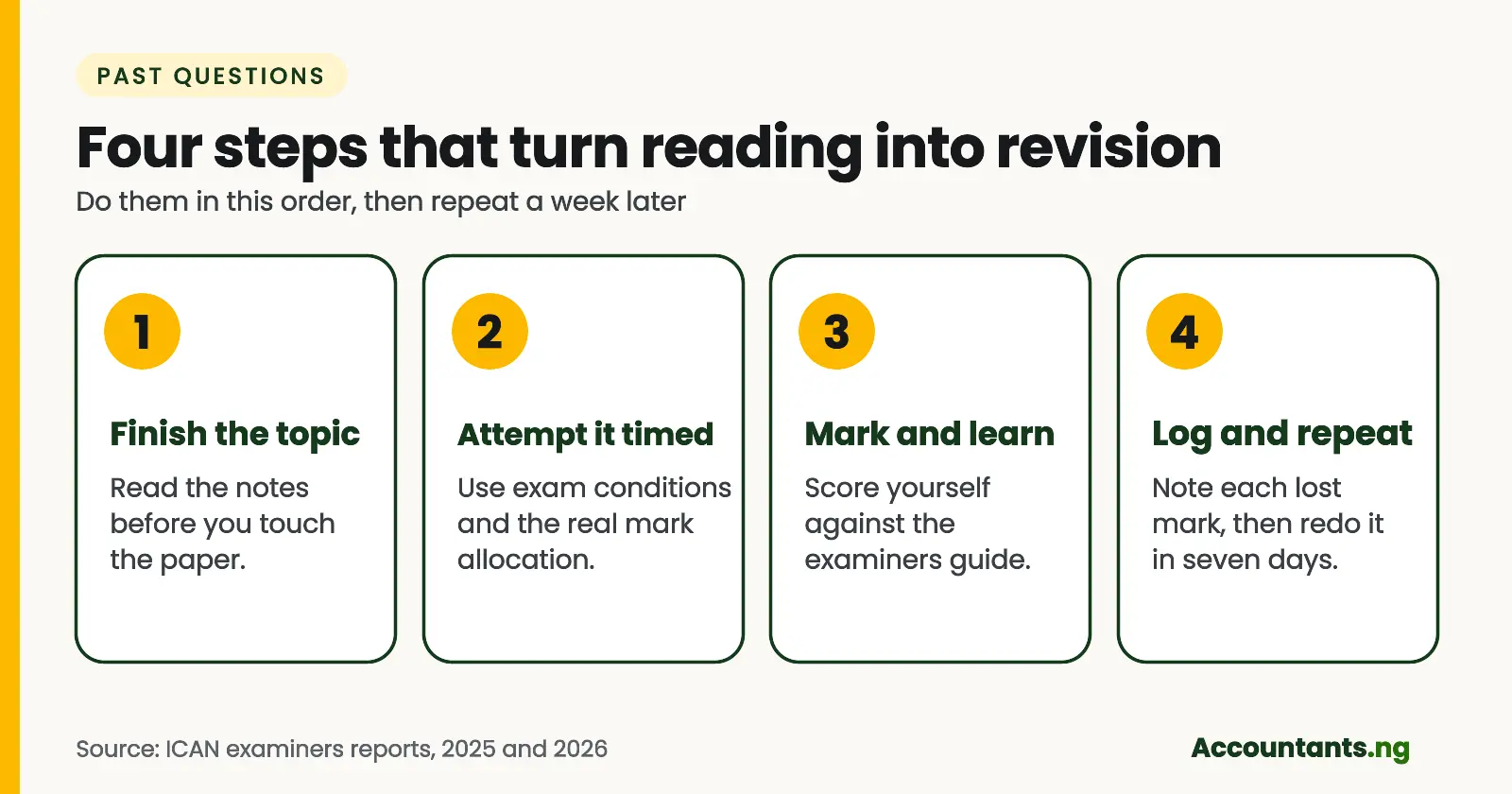
Step 1: finish the topic first
Read the topic notes before you attempt questions on it. Our Foundation level pages link each topic to its past questions. Examiners also point candidates to the ICAN study text, so use it beside your notes.
A question tried cold is useful only if you then study the answer closely. That is a slow way to learn basics.
Step 2: attempt it under exam conditions
Pick a course, a year and a diet on the past questions page. Start with the most recent paper, then work backwards.
Set a timer at 1.8 minutes a mark, the rule in our guide to the Foundation paper structure. For Management Accounting Question 1 that gives about 14, 14 and 7 minutes for parts (a), (b) and (c). Write by hand, put your phone away and keep the answer closed.
Once you have covered the syllabus, sit a whole paper in one go: 20 multiple-choice questions and four written answers in 3¼ hours. It trains the choosing as well as the writing.
Step 3: mark yourself against the guide
Open the suggested answer and the marking guide. Count your ticks the way the examiner would. For part (c) above, your gross profit should read ₦52,850 under FIFO and ₦52,700 under LIFO.
The guides show where marks sit. In Management Accounting Question 2(b) of May 2026, each big-data feature earns 1 mark for stating it and 1 for explaining it. A bare list of five names earns half the marks.
Then read the examiner's report. For that question it says about 40% attempted it, about 65% cleared 50% on part (a) and only about 30% on part (b). The examiner blamed a topic few had prepared. Check whether your lost ticks match the pitfalls named.
For every mark you lose, write down why. There are usually three reasons:
- You did not know it. The fix is the topic notes.
- You knew it but ran out of time. The fix is more timed practice.
- You misread the question. The fix is to read the Required lines first. Our guide A 20-mark question can hide two jobs shows how.
The label matters because each reason needs a different fix. Re-reading the notes will not cure a timing problem.
Step 4: go back to the notes and log the error
Revise the exact section, not the whole course. Then write one line per mistake.
| Question | Marks lost | Reason | Fix |
|---|---|---|---|
| Example: stores ledger, part (c) | 4 | Closing stock not carried over | Redo (a) and (b), then build (c) from their closing figures |
That entry is an illustration. Your own log will show patterns after a few papers.
After five papers, count the reasons. If most lines say you ran out of time, stop re-reading and drill speed. If most say you did not know it, go back to the study text. The log tells you which kind of revision you need.
Step 5: repeat it a week later
Try the same question again, from memory, with the same time limit. If you reach the same ticks without the answer, you have learned the topic. If you cannot, it goes back on your list.
Topics return across diets. Standard costing was Question 6 in both November 2025 and May 2026 Management Accounting, so a topic you learn once can pay twice.
What should the end of every session look like?
One marked question beats three skimmed. Finish each session with a gap you can name, such as part (c), and a date to retest it. Before you start, see how the marks are spread in how to spend 1.8 minutes on every mark.
Frequently asked questions
Where can I find ICAN past questions with answers?
ICAN publishes them as Pathfinder, issued by diet and level. Our past questions page lists Financial Accounting from May 2025, and Business Environment, Management Accounting and Corporate and Business Law from November 2025, with examiners' reports and marking guides where ICAN published them. Older papers follow the previous syllabus.
Should I attempt past questions before I finish the syllabus?
Finish a topic first. A question you cannot start teaches you little, and many examiners' reports send candidates back to the ICAN study text. Once a topic is covered, attempt questions on that topic only, and mark each one against the guide before you move on.
How do I mark myself against an ICAN marking guide?
Count ticks. ICAN guides often pay half a mark per tick, as in May 2026 Management Accounting Question 1, where part (a) is 16 ticks for 8 marks. Tick your answer line by line, total the marks, then write the cause beside every tick you missed.
How often should I repeat a past question?
Repeat it a week later, from memory, under the same time limit. If you reach the same ticks without the answer in front of you, the topic is learned. If you do not, it goes back on your list. This is our advice, not an ICAN rule.
Do ICAN questions repeat exactly?
No. Topics return, but the questions change. Three of the six Management Accounting questions in May 2026 covered topics from November 2025: marginal and absorption costing, optimal production mix and standard costing. Learn the topic and the method, because memorising one answer will not carry over.
What does an examiner's report tell me?
It states how many candidates attempted a question, how many scored 50% or more, and the common pitfalls. Read it after you mark yourself, because the pitfalls often match your own lost ticks. We show each report beside its question wherever ICAN published one.
Pick one question from our ICAN past questions and start the timer.
Keep reading

JAMB subject combination for accounting: 20 top universities
The JAMB subject combination for accounting, and the fourth-subject rule at 10 top public and 10 top private universities, checked against the brochure.
9 Nov 2026 8 min read
Accounting Cut-Off Marks for Nigerian Universities (2026)
The 2026 JAMB floor, each university minimum UTME score and the UNILAG Accounting merit figure, with a source beside every number.
7 Nov 2026 9 min read
32 VAT Exempted & Zero-rated Goods & Services in Nigeria
All 17 zero-rated and 15 exempt goods and services under the Nigeria Tax Act 2025, and what the difference costs a seller in input...
7 Nov 2026 9 min readGet new articles by email
Exam tips, study guides and the law in plain English. No spam, and you can leave at any time.