ICAN Foundation Exam Structure and Time Plan
Every ICAN Foundation paper has 20 multiple-choice questions and six written questions, of which you answer four, and the examiners' reports show how to choose them.

The ICAN Foundation exam structure is the same for all four papers: 20 compulsory one-mark multiple-choice questions, then six 20-mark written questions, of which you answer four. You get three hours plus 15 minutes of reading time. The pass mark is 50% for each paper, and ICAN sets the exams in May and November.
Here is what most candidates miss. The optimal production mix question in Management Accounting drew only about 25% of candidates in November 2025, and about 20% of them cleared 50%. In May 2026 the same topic drew about 75%, and over 75% of them cleared 50%. Both reports sit on our November 2025 and May 2026 pages.
Same topic, opposite outcomes. Choosing your four questions is a skill, and it starts with the layout, the clock and the marking. This article gives you all three, using ICAN's syllabus and examiners' reports.
What does ICAN set for every Foundation paper?
The rules come from ICAN's updated syllabus, which applies from the November 2025 diet. It adds that Foundation papers “may be paper-based or computer-based”, so read the instructions on your own paper.
| Item | Rule | Source |
|---|---|---|
| Papers | Business Environment, Financial Accounting, Management Accounting, Corporate and Business Law | Syllabus 17.1 |
| Section A | 20 compulsory multiple-choice questions, 20% of the marks | Syllabus 19 |
| Section B | Six questions of 20 marks, answer any four | Syllabus 19 |
| Time | Three hours plus 15 minutes reading | Syllabus 19 |
| Pass mark | 50% for each paper | Syllabus 17.9 |
| Diets | May and November; entries close a week before | Syllabus 17.4, 17.6 |
| November 2026 | Foundation papers between 10 and 12 November | ICAN timetable |
The May 2026 Management Accounting, Business Environment and Corporate and Business Law papers on our past questions page match this layout.
How many minutes is each mark worth?
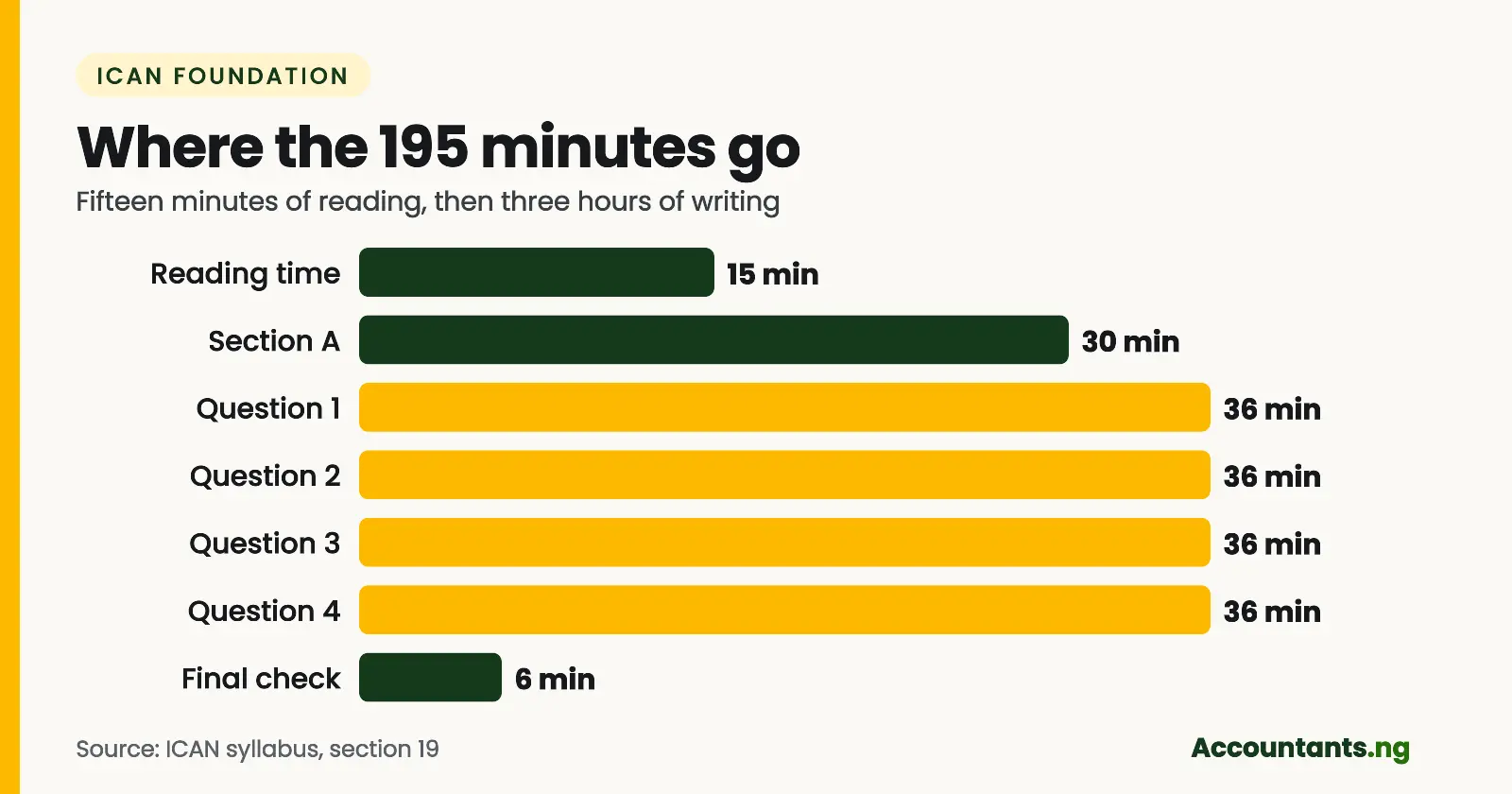
After the reading time you write for 180 minutes. Divide by 100 marks and you get 1.8 minutes a mark. ICAN does not publish that rule. It is our planning aid, and it stops any one question from stealing time. Here is the full plan, with six minutes held back for checking.
| Block | Marks | Minutes | Clock |
|---|---|---|---|
| Reading time | 0 | 15 | 0:00 to 0:15 |
| Section A | 20 | 30 | 0:15 to 0:45 |
| Question 1 | 20 | 36 | 0:45 to 1:21 |
| Question 2 | 20 | 36 | 1:21 to 1:57 |
| Question 3 | 20 | 36 | 1:57 to 2:33 |
| Question 4 | 20 | 36 | 2:33 to 3:09 |
| Final check | 0 | 6 | 3:09 to 3:15 |
Section A gets 30 minutes, 1.5 minutes a question. Skip any that stall you and return at the end.
ICAN's marking guides pay in half marks. Part (a) of Management Accounting Question 1 in May 2026 carried 8 marks for 16 ticks at half a mark each. One tick is worth about 54 seconds. A figure you cannot reach in a minute is a figure to flag and revisit.
When the clock says move on, move on. The guides award ticks step by step, so a half-finished answer still collects marks, while an unstarted fourth question collects none.
What does a 20-mark question look like inside?
Marks are split into parts, and the parts are rarely equal. Four May 2026 questions show it.
| Question | Parts and marks | Minutes |
|---|---|---|
| Management Accounting Q1 | FIFO ledger 8, LIFO ledger 8, operating statement 4 | 14, 14, 7 |
| Management Accounting Q2 | Expenditure codes 10, five features of big data 10 | 18, 18 |
| Business Environment Q5 | Law of demand 2½, five determinants 7½, curve movement and shift 10 | 4½, 13½, 18 |
| Corporate and Business Law Q1 | Six parts: 4, 2, 4, 2, 2 and 6 marks | 7, 4, 7, 4, 4, 11 |
Two lessons follow. First, explanation outweighs listing. In Business Environment Question 3(a) of May 2026, stating five types of internal audit earned 2½ marks and explaining them earned 5. In Management Accounting Question 2(b), the guide gives 1 mark for stating each big-data feature and 1 for explaining it.
Second, one question can cover four topics. Law Question 1 spans personal representatives, auditor reappointment, insurance and trust investments. ICAN's syllabus says it may examine any topic at any diet, so skipping chapters is a gamble.
Which four questions should you answer?
The examiners' reports for Management Accounting show how candidates chose, and how that went.
| Diet and question | Topic | Attempted | Scored 50%+ |
|---|---|---|---|
| Nov 2025 Q4 | Optimal production mix | about 25% | about 20% |
| May 2026 Q5 | Optimal production mix | about 75% | over 75% |
| Nov 2025 Q3 | Fixed and variable costs | about 40% | about 20% |
| May 2026 Q1 | FIFO and LIFO stores ledgers | about 75% | about 70% |
| May 2026 Q2 | Cost coding; big data | about 40% | 65% on (a), 30% on (b) |
Source: examiners' reports on our November 2025 and May 2026 Management Accounting pages. The percentages are as the examiners reported them, and they refer to candidates who attempted each question.
The pattern is plain: the questions most candidates attempted tended to score better. The reports do not say why. Of Question 2(b) in May 2026, the examiner wrote that big data “is obviously not a popular one, therefore not well prepared for”.
Topics also come back. Three of the six May 2026 questions repeated a November 2025 topic: marginal and absorption costing (about 40% cleared 50% in November, about 55% in May), optimal production mix, and standard costing (about 25% in November, about 50% in May). A topic you skipped last diet is a likely target.
Popularity does not guarantee marks. In November 2025 about 67% attempted Business Environment Question 6 on the Internet of Things, yet about 18% scored above average. Rank questions by your own marks, not by the crowd.
- Spend the 15 reading minutes on all six questions, not just the first.
- Beside each part, tick the marks you could earn without notes.
- Choose the four questions with the most ticked marks.
- Write a start time beside each, then take your surest question first.
Our guide A 20-mark question can hide two jobs shows how to find those marks before you write.
Where do candidates lose marks?
The May 2026 examiners' reports name the pitfalls. Four stand out:
- Missing a link between parts. Some Management Accounting candidates could not prepare the operating statement in Question 1(c), which needs the closing inventory from both ledgers.
- Skipping details. In Question 3 on service costing, the examiner said some candidates “missed out some tiny details”.
- Wrong-sided entries. In Financial Accounting Question 2, candidates omitted contra entries and posted discounts to the wrong side of the cash book.
- Misreading the scenario. In Financial Accounting Question 1, many treated a company as a sole trader.
Each is a habit you can fix in timed practice. The five steps in how to revise with past questions show how.
What changed in the 2025 syllabus?
The 2025 syllabus applies from the November 2025 diet. Business Management and Finance became Business Environment, Management Information became Management Accounting, and Business Law became Corporate and Business Law. Candidates who had passed Management Information by May 2025 were credited with Management Accounting. Our Foundation level guide lists the four papers.
Frequently asked questions
How many questions are in an ICAN Foundation paper?
Each paper has 26 questions: 20 compulsory multiple-choice questions worth one mark each, and six written questions worth 20 marks each. You answer all 20 multiple-choice questions and any four written ones. ICAN's syllabus sets this layout for all four Foundation papers, which gives 100 marks.
What is the ICAN Foundation pass mark?
ICAN's syllabus sets the pass mark at 50% for each paper. You are credited for each paper you pass, so passing Financial Accounting stands even if you fail Management Accounting. The syllabus expects you to complete every Foundation paper before you move up to the Skills level.
How long is an ICAN Foundation paper?
Three hours of writing plus 15 minutes of reading time, which is 3¼ hours in total. The 1.8 minutes a mark rule is a planning aid we use, not an ICAN rule. It comes from dividing the 180 writing minutes by the 100 marks on the paper.
When are the ICAN exam diets?
ICAN holds its examinations twice a year, in May and November, and entries close one week before the exam dates. Its November 2026 timetable places the Foundation papers between Tuesday 10 and Thursday 12 November 2026. Check ICAN's own notice for your centre and paper slot.
Can I choose which four written questions to answer?
Yes. The syllabus says candidates attempt any four of the six. Use the 15 minutes of reading time to rank all six by the marks you are sure of. Examiners' reports show that popular questions often score better, but a popular question can still go badly.
Are the past papers on this site from ICAN?
They are built from ICAN's Pathfinder publications, with the examiners' reports and marking guides where ICAN published them. We hold Financial Accounting from May 2025, and Business Environment, Management Accounting and Corporate and Business Law from November 2025. Older papers follow the previous syllabus.
Sit a timed Foundation paper today from our ICAN past questions.
Keep reading

JAMB subject combination for accounting: 20 top universities
The JAMB subject combination for accounting, and the fourth-subject rule at 10 top public and 10 top private universities, checked against the brochure.
9 Nov 2026 8 min read
Accounting Cut-Off Marks for Nigerian Universities (2026)
The 2026 JAMB floor, each university minimum UTME score and the UNILAG Accounting merit figure, with a source beside every number.
7 Nov 2026 9 min read
32 VAT Exempted & Zero-rated Goods & Services in Nigeria
All 17 zero-rated and 15 exempt goods and services under the Nigeria Tax Act 2025, and what the difference costs a seller in input...
7 Nov 2026 9 min readGet new articles by email
Exam tips, study guides and the law in plain English. No spam, and you can leave at any time.