Accounting conventions: consistency, prudence, materiality
The four accounting conventions, consistency, prudence, materiality and full disclosure, with their IFRS basis and a naira example for each.

Accounting conventions are accepted practices that guide judgement when financial statements are prepared. The four usually listed are consistency, prudence (also called conservatism), materiality and full disclosure. Concepts set the ground rules of accounting; conventions decide how those rules are applied when a choice or an estimate is needed.
This guide covers:
- what a convention is and how it differs from a concept
- the four accounting conventions, each with its IFRS basis
- a worked naira example for each one
- how ICAN tests them in Financial Accounting
What are accounting conventions?
An accounting convention is a statement of practice that accountants follow because it is generally accepted, not because one rule spells it out. Textbooks commonly define concepts as the basic assumptions on which transactions are recorded, and conventions as the accepted methods used in recording and presenting them.
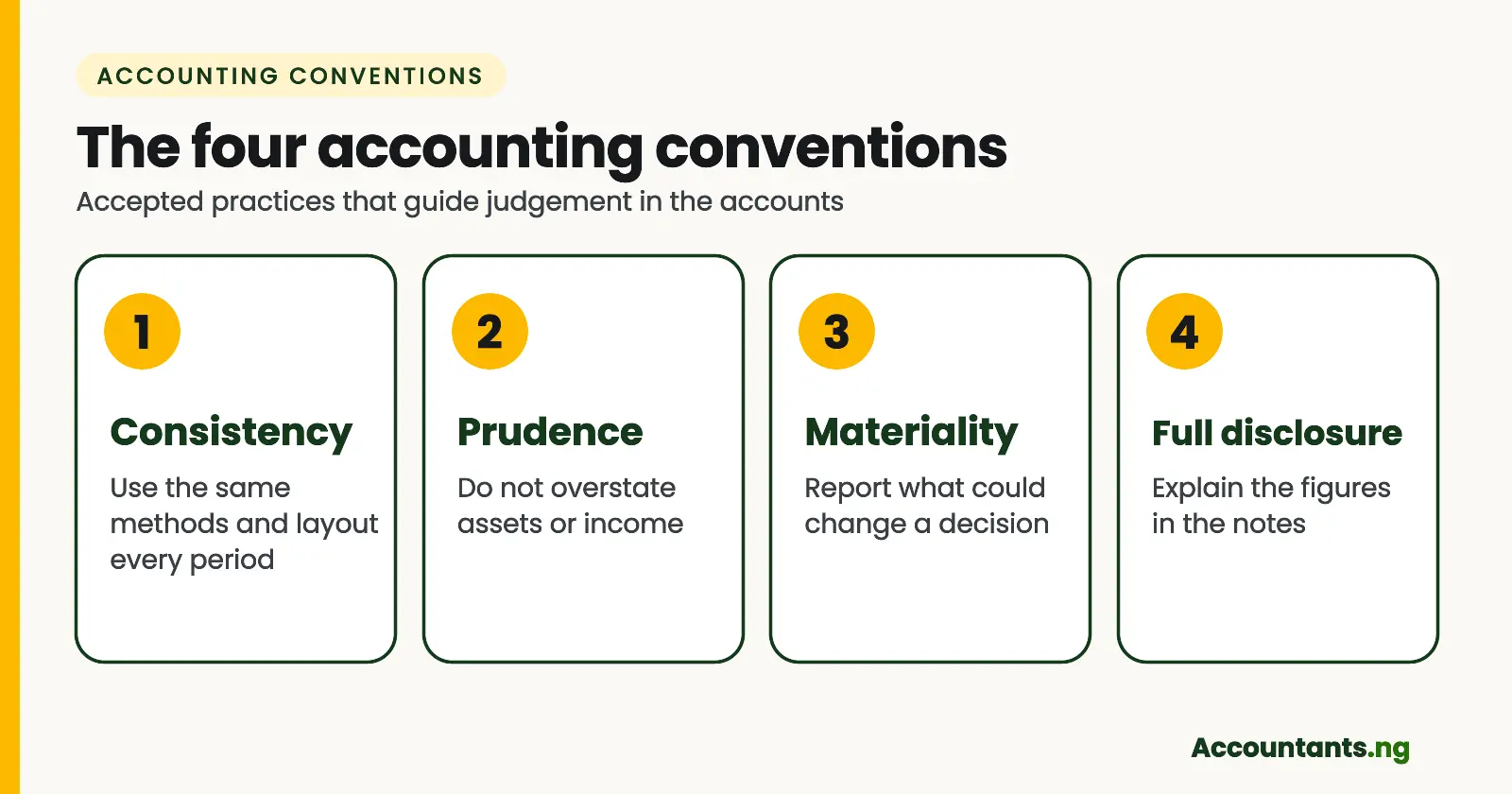
The four accounting conventions:
- Consistency: use the same methods from one period to the next
- Prudence or conservatism: take care not to overstate assets and income or understate liabilities and expenses
- Materiality: focus on information that could affect users' decisions
- Full disclosure: give all the information users need to understand the figures
Accounting concepts and conventions: what is the difference?
Concepts such as business entity, going concern, accrual and historical cost are covered in the guide to accounting concepts with examples. The difference in short:
| Point | Concepts | Conventions |
|---|---|---|
| What they are | Basic assumptions | Accepted practices |
| Question answered | What are the ground rules? | How should judgement work? |
| Examples | Going concern, accrual | Consistency, materiality |
The line is not fixed. ICAN does not separate the two: its Foundation Financial Accounting syllabus asks candidates to "explain the following accounting concepts and conventions" and lists materiality, consistency of presentation and prudence in the same list as going concern and accrual.
Convention of consistency
The consistency convention means an entity uses the same accounting methods and presentation every period, so results can be compared over time. IFRS sets it out in two places:
- IAS 8, paragraph 13: accounting policies must be applied consistently for similar transactions
- IAS 1, paragraph 45: presentation and classification of items must be kept from one period to the next
Under IAS 8, paragraph 14, a policy may change only if an IFRS requires it or if the change gives reliable and more relevant information. A voluntary change is applied retrospectively, which means restating the comparative figures.
Example: an invented Lagos distributor, Adaeze Traders, depreciates its delivery vans on the straight-line basis. A switch to reducing balance just to lift this year's profit is not allowed. If the switch gives more relevant information, the prior year figures are restated so both years use the same method.
Convention of conservatism (prudence)
Prudence is the convention of caution under uncertainty. The 2018 IFRS Conceptual Framework, paragraph 2.16, defines it as "the exercise of caution when making judgements under conditions of uncertainty", so that assets and income are not overstated and liabilities and expenses are not understated.
Two points matter for exams:
- The IASB removed prudence from the Framework in 2010 and brought it back in 2018. The 2018 version does not allow deliberate understatement of profit.
- The older conservatism rule, "anticipate no profit, but provide for all possible losses", is textbook wording, not IFRS wording. Some standards still treat gains and losses differently, which ACCA calls asymmetric prudence.
Prudence in the standards
- IAS 2: inventories are measured at the lower of cost and net realisable value
- IAS 37: a provision is recognised when an outflow is probable; a contingent asset is not recognised, and is disclosed only when an inflow is probable
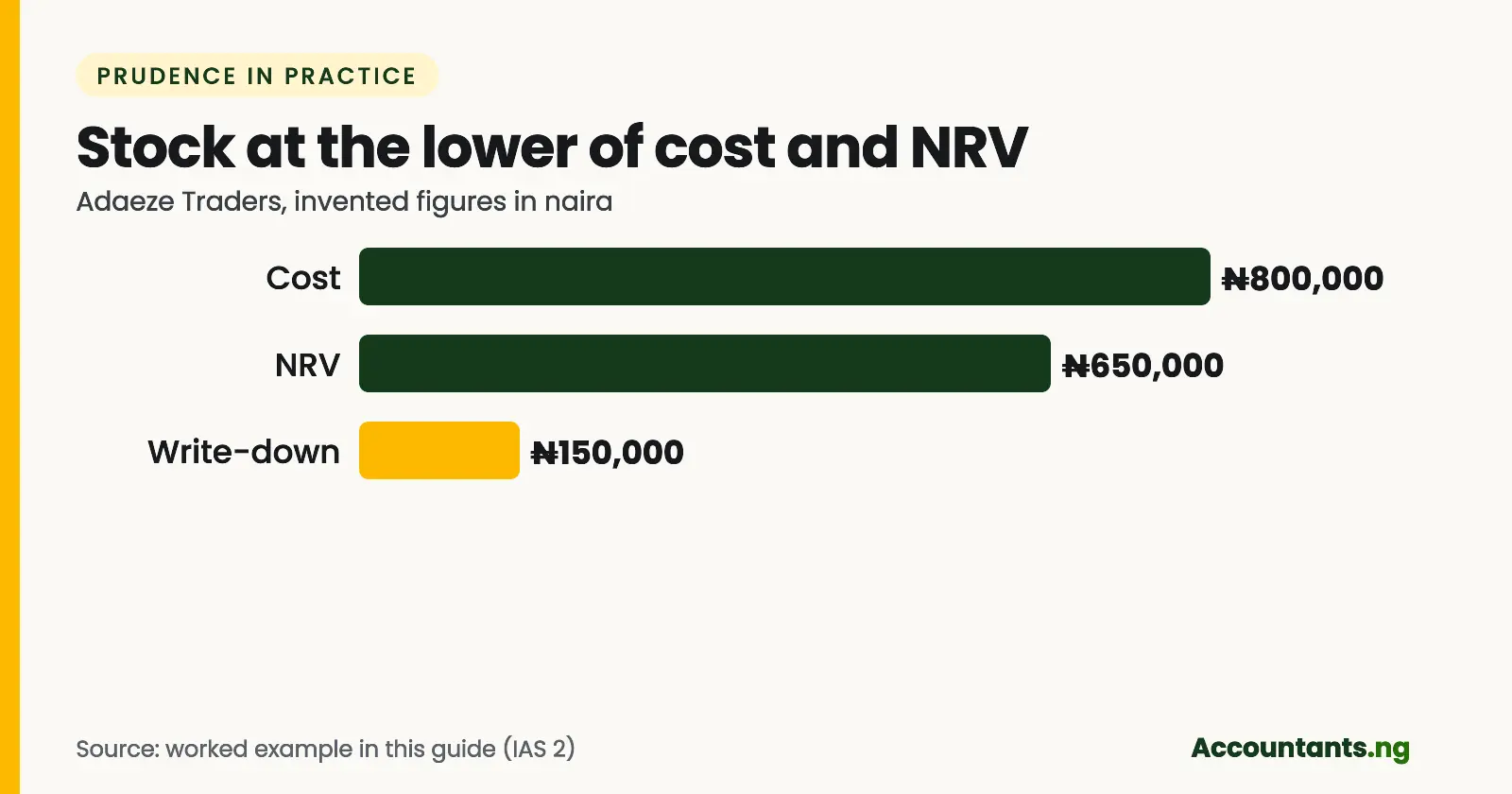
Example: Adaeze Traders holds stock that cost ₦800,000. Its net realisable value, the estimated selling price less the costs to complete and sell, is ₦650,000. The stock is written down by ₦150,000 to ₦650,000.
Materiality concept
Materiality decides what is worth reporting separately. The IASB's definition of material, issued in October 2018 and effective from 1 January 2020, reads: information is material if omitting, misstating or obscuring it could reasonably be expected to influence decisions that the primary users of financial statements make.
Key points:
- Materiality depends on the nature or size of an item, or both.
- The Conceptual Framework (paragraph 2.11) says the IASB cannot set a single number threshold.
- IFRS Practice Statement 2, Making Materiality Judgements, issued on 14 September 2017, gives non-mandatory guidance.
Example: a ₦4,500 stapler that will last years is expensed, not capitalised as equipment, because the amount would not change any user's decision. A small payment to a director, by contrast, may be material by nature because users care about related party transactions.
Full disclosure convention
The full disclosure convention requires financial statements to give all information needed for a fair view, including notes. "Full disclosure" is a textbook label rather than an IFRS term. In IFRS it sits under fair presentation: IAS 1, paragraph 17(c), requires extra disclosures when meeting the specific requirements of a standard is not enough for users to understand the effect of transactions.
Example: Adaeze Traders is being sued by a customer and its lawyers judge an outflow possible but not probable. No provision is made, but the contingent liability is disclosed in the notes unless the chance of payment is remote (IAS 37).
Accounting conventions with examples: summary table
| Convention | Rule | Adaeze Traders example |
|---|---|---|
| Consistency | Same methods each period | Keep straight-line depreciation |
| Prudence | Do not overstate assets | Stock written down by ₦150,000 |
| Materiality | Report what affects decisions | ₦4,500 stapler expensed |
| Full disclosure | Explain in the notes | Lawsuit disclosed as contingent |
Accounting conventions under IFRS 18 from 2027
IFRS 18 replaces IAS 1 for periods beginning on or after 1 January 2027. The conventions stay, but their homes move:
- the definition of material moves to Appendix A of IFRS 18, and IAS 8 refers to it
- consistency of presentation moves to IFRS 18, paragraph 30
- consistency of accounting policies stays in IAS 8, which is renamed Basis of Preparation of Financial Statements
Nigeria applies new IFRS as issued, as explained in the guide to accounting standards in Nigeria.
How ICAN tests accounting conventions
The ICAN syllabus places concepts and conventions in Section A, Accounting Framework, of the Foundation Financial Accounting paper. That section carries 10% of the marks. Typical questions:
- define a convention and give an example
- state which convention explains a treatment, such as inventory at the lower of cost and net realisable value
- explain why a change of depreciation method needs justification
The same ideas return at Skills level in the Financial Reporting notes. For the full set of principles, go back to the accounting principles guide.
Frequently asked questions
What are accounting conventions?
Accounting conventions are generally accepted practices that guide how transactions are recorded and presented when judgement is needed. The four usually listed are consistency, prudence or conservatism, materiality and full disclosure. They sit alongside accounting concepts such as going concern and accrual, and ICAN tests both together in Foundation Financial Accounting.
What is the difference between accounting concepts and conventions?
Concepts are the basic assumptions behind accounting, such as business entity, going concern and accrual. Conventions are the accepted practices for applying those assumptions, such as consistency and materiality. The boundary is not fixed: different textbooks file the same idea under different headings, and ICAN lists both in one syllabus item.
What is the convention of conservatism?
Conservatism is the older name for prudence. The traditional rule was to anticipate no profit but provide for all possible losses. The 2018 IFRS Conceptual Framework now describes prudence as caution under uncertainty, so assets and income are not overstated and liabilities and expenses are not understated, without deliberate understatement.
What is the materiality concept with an example?
Materiality means information is reported separately if omitting, misstating or obscuring it could influence users' decisions. For example, a ₦4,500 stapler is expensed rather than recorded as equipment, because the amount changes no decision. A small payment to a director may still be material because of its nature.
Why is the consistency convention important?
Consistency lets users compare one year with the next. If methods changed every year, a rise in profit could come from a new method rather than better trading. IAS 8 allows a policy change only when a standard requires it or it gives reliable and more relevant information, with comparatives restated.
Is prudence still part of IFRS?
Yes. The IASB removed prudence from the Conceptual Framework in 2010 and reinstated it in March 2018, in paragraph 2.16. The current wording describes prudence as the exercise of caution when making judgements under uncertainty and supports neutrality. It does not permit hidden reserves or deliberate understatement of profit.