Accounting standards in Nigeria: IFRS, IAS, IPSAS and who sets them
Who sets accounting standards in Nigeria, which entities use IFRS, IFRS for SMEs or IPSAS, and the key adoption dates from 2012 to 2030.
Accounting standards in Nigeria are set by the Financial Reporting Council of Nigeria (FRC), which requires international standards rather than local ones. Listed companies and other public interest entities use IFRS Accounting Standards, qualifying small companies use IFRS for SMEs, and governments use IPSAS. Sustainability reporting under IFRS S1 and S2 becomes mandatory from 2028.
This guide covers four things:
- who sets and enforces accounting standards in Nigeria
- which standard each type of entity uses
- the adoption dates for IFRS and IPSAS
- how IFRS, IAS and IPSAS differ
All dates and rules are stated as at 11 November 2026.
Who sets accounting standards in Nigeria?
The Financial Reporting Council of Nigeria sets them. The FRC was created by the Financial Reporting Council of Nigeria Act No. 6 of 2011, signed on 3 June 2011. That Act repealed the Nigerian Accounting Standards Board Act of 2003 and replaced the old board with the council.
The FRC lists its functions as:
- setting and adopting accounting standards for the private and public sectors
- setting auditing, actuarial, valuation and corporate governance standards
- monitoring compliance by reviewing the financial statements of public interest entities
- registering the professionals who prepare and audit those financial statements
What did the FRC (Amendment) Act 2023 change?
The FRC (Amendment) Act 2023 was signed on 3 May 2023, according to the FRC and PwC Nigeria. The main changes:
- a wider definition of a public interest entity, which now takes in government bodies and some government contractors
- a duty to comply with standards issued by both the IFRS Foundation and the International Public Sector Accounting Standards Board (IPSASB)
- a national repository for the financial statements of public interest entities
What was the Nigerian Accounting Standards Board?
The Nigerian Accounting Standards Board (NASB) was the standard setter before the FRC. It was set up on 9 September 1982 as a private-sector initiative and issued local Statements of Accounting Standards (SAS).
Since IFRS adoption in 2012, Nigerian entities report under international standards. SAS now appear mainly in older financial statements and in questions on the history of standard setting.
Which accounting standards apply in Nigeria?
The standard depends on the type of entity.
| Entity | Standard | Required from |
|---|---|---|
| Listed and significant public interest entities | IFRS Accounting Standards | 1 January 2012 |
| Other public interest entities | IFRS Accounting Standards | 1 January 2013 |
| Qualifying small and medium entities | IFRS for SMEs | 1 January 2014 |
| Federal, state and local governments | Accrual IPSAS | 1 January 2016 |
Source: IFRS Foundation Nigeria profile, PwC Nigeria (September 2010) and the FAAC guidelines on IPSAS implementation (May 2015).
Adoption of IFRS in Nigeria
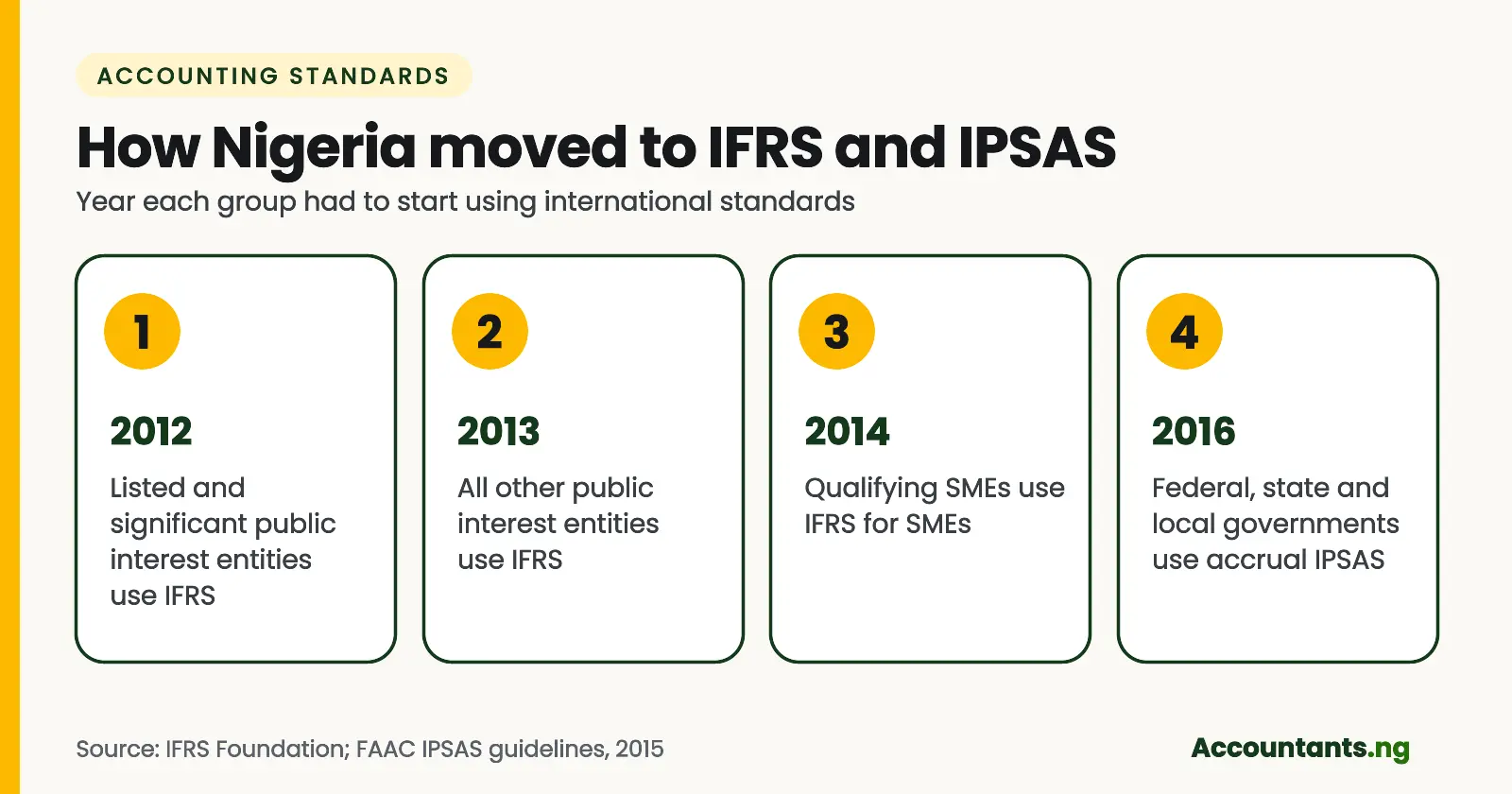
The Federal Executive Council approved IFRS adoption on 28 July 2010. The roadmap was unveiled on 2 September 2010 and ran in three phases:
- Phase 1: listed companies and significant public interest entities, from 1 January 2012
- Phase 2: all other public interest entities, from 1 January 2013
- Phase 3: small and medium entities using IFRS for SMEs, from 1 January 2014
Nigeria adopted IFRS without changes. The IFRS Foundation's Nigeria profile records that Nigeria has not modified any IFRS Standard and has no separate endorsement process. New standards therefore apply as the International Accounting Standards Board (IASB) issues them.
One example is IFRS 18 Presentation and Disclosure in Financial Statements. It replaces IAS 1 for periods beginning on or after 1 January 2027.
Adoption of IPSAS in Nigeria
IPSAS are the International Public Sector Accounting Standards, issued by the IPSASB for governments and other public bodies. Nigeria moved to them in stages:
- July 2010: the Federal Executive Council adopted IPSAS
- 2014: governments prepared financial statements on the cash basis IPSAS
- 1 January 2016: accrual basis IPSAS for federal, state and local governments, under guidelines issued in May 2015 by the FAAC Sub-committee on IPSAS implementation
Progress was uneven. ACCA reported in 2020 that many states had missed the 2016 date and had been directed to comply by the end of 2020. The 2023 amendment to the FRC Act now ties public sector reporting to IPSASB standards in law.
The topic is covered in depth in the ICAN Public Sector Accounting and Finance notes.
What is the difference between IFRS and IAS?
IAS and IFRS are both international standards. The difference is the body that issued them:
- IAS (International Accounting Standards) were issued by the International Accounting Standards Committee (IASC) up to 2001
- IFRS (International Financial Reporting Standards) are issued by the IASB, which replaced the IASC in 2001
In April 2001 the IASB resolved that the existing IAS continue to apply until they are amended or withdrawn. So IAS 2 Inventories, IAS 16 Property, Plant and Equipment and IAS 37 Provisions still form part of the IFRS Accounting Standards used in Nigeria.
| Item | IAS | IFRS |
|---|---|---|
| Issuer | IASC | IASB |
| Period issued | Up to 2001 | From 2001 |
| Still in use? | Yes, unless replaced | Yes |
| Example | IAS 2 Inventories | IFRS 16 Leases |
The IFRS Foundation also oversees the International Sustainability Standards Board (ISSB), which works alongside the IASB and issues IFRS S1 and IFRS S2.
Sustainability reporting standards in Nigeria
Nigeria announced at COP27 on 8 November 2022 that it would adopt the ISSB standards. The FRC launched its adoption roadmap on 22 March 2024. Under the FRC's amended roadmap:
- Early adopters: may apply IFRS S1 and S2 for periods from 1 January 2024
- Voluntary period: 2024 to 2027
- Public interest entities: mandatory for periods from 1 January 2028
- SMEs: mandatory for periods from 1 January 2030
- Government: from 2028, using the IPSASB sustainability standard SRS 1
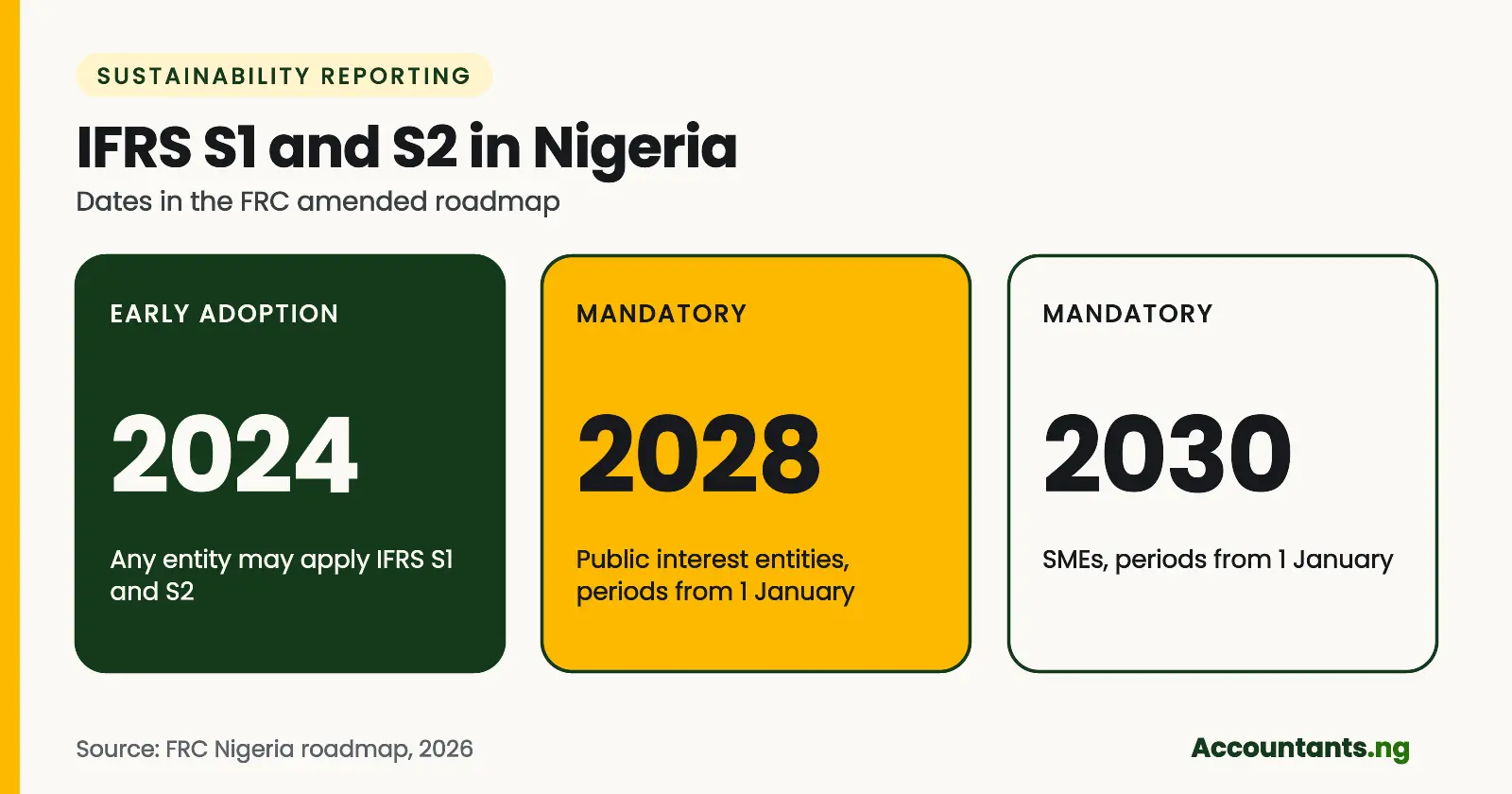
An older version of the plan gave 2027 as the mandatory date. The amended roadmap uses 2028.
Who else shapes financial reporting in Nigeria?
The FRC sets the standards, but other bodies and laws matter:
- ICAN (set up under the ICAN Act 1965) and ANAN (set up under the ANAN Act 1993) are professional accountancy bodies. Both are IFAC members. Neither sets accounting standards.
- The Companies and Allied Matters Act 2020 requires companies to keep accounting records and prepare financial statements.
- The Nigeria Tax Act 2025 decides how the profit in those statements is taxed. Accounting profit and taxable profit are rarely the same figure.
How accounting standards appear in ICAN exams
ICAN tests IFRS in its Financial Reporting paper at the Skills level and IPSAS in Public Sector Accounting and Finance. The principles behind the standards, such as going concern, accrual and prudence, are tested earlier at Foundation level.
For the ideas the standards rest on, read the guides to accounting concepts with examples and basic accounting principles for beginners, or return to the accounting principles guide.
Frequently asked questions
Who sets accounting standards in Nigeria?
The Financial Reporting Council of Nigeria sets accounting standards in Nigeria. It was created by the FRC Act 2011, which replaced the Nigerian Accounting Standards Board. The FRC requires international standards: IFRS Accounting Standards for public interest entities, IFRS for SMEs for qualifying small entities and IPSAS for the public sector.
When did Nigeria adopt IFRS?
The Federal Executive Council approved IFRS adoption on 28 July 2010. Listed companies and significant public interest entities applied IFRS from 1 January 2012, other public interest entities from 1 January 2013, and qualifying small and medium entities used IFRS for SMEs from 1 January 2014, under the national roadmap.
What replaced the Nigerian Accounting Standards Board?
The Financial Reporting Council of Nigeria replaced it. The FRC Act No. 6 of 2011, signed on 3 June 2011, repealed the NASB Act of 2003. The NASB had been set up in 1982 and issued local Statements of Accounting Standards, which gave way to IFRS from 2012.
Do Nigerian governments use IFRS?
No. Federal, state and local governments use IPSAS, the International Public Sector Accounting Standards. Nigeria adopted IPSAS in 2010, used the cash basis for 2014 statements and set accrual IPSAS from 1 January 2016. The 2023 amendment to the FRC Act also requires compliance with IPSASB standards for the public sector.
Is IAS still used in Nigeria?
Yes. IAS issued before 2001 remain in force until the IASB amends or withdraws them, so standards such as IAS 2 Inventories and IAS 16 Property, Plant and Equipment still apply. Because Nigeria has no endorsement process, any IAS replaced by a new IFRS, such as IAS 1 by IFRS 18, falls away here too.
When will IFRS S1 and S2 be mandatory in Nigeria?
Under the FRC's amended roadmap, IFRS S1 and S2 become mandatory for public interest entities for periods beginning on or after 1 January 2028 and for SMEs from 1 January 2030. Early adoption has been allowed since 2024, and governments follow the IPSASB standard from 2028.